Shashank Joshi is a food processing consultant with over 33 years of experience in product development, manufacturing operations, quality, food safety, regulatory compliance and business transformation. His strength lies in converting innovative ideas into commercially successful products while building world-class, compliant and sustainable food manufacturing systems.
- You have over 33 years of experience in the food industry. What are the biggest changes you have seen in food manufacturing, and what challenges still remain unresolved?
Over the last 33 years, I have witnessed a significant shift from traditional, labour-intensive manufacturing to automation, advanced processing, and data-driven quality management. Food safety, traceability, packaging, and shelf-life management have also improved considerably. However, inconsistent quality, limited automation in traditional Indian foods, high manufacturing costs, and gaps between R&D and production remain major challenges. The industry needs to focus on practical technology adoption, skill development, and stronger process discipline.
- Many food businesses develop promising products but struggle to bring them successfully to market. What are the most common mistakes companies make when moving from product development to commercial production?
The biggest mistake is treating product development and commercial manufacturing as two separate activities. A product that works in the laboratory may behave differently at an industrial scale due to variations in equipment, processing conditions, and raw materials. Companies often underestimate shelf-life validation, packaging compatibility, production costs, and regulatory compliance, and product claims on label. Successful commercialisation requires a well-defined scale-up plan, process validation, and consistent product quality before market launch, and revising product after analysing the product feedback from the market.
- Consumers increasingly look for clean-label products with simpler ingredients. How can manufacturers meet this demand while maintaining taste, shelf life, affordability and product stability?
Clean-label development should begin with understanding the product’s actual functional requirements rather than simply removing ingredients. Manufacturers can use appropriate processing technologies, better raw material selection, natural preservation strategies, and improved packaging to maintain safety and stability. Clean label is perceived as a game changer,especially for the Premium segment. However, clean-label does not automatically mean preservative-free or additive-free; every formulation must be scientifically validated. The objective is to achieve a balance between consumer expectations, product safety, taste, shelf life, and affordability.However we can achieve a product without additive or preservative free, provided product characteristics and taste etc remain the same.
- Automation is becoming increasingly important in food manufacturing. Which processes offer the greatest opportunities for automation, and how can smaller manufacturers adopt technology without making unnecessarily large investments?
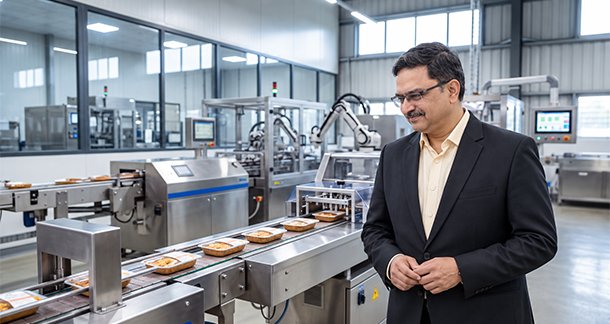
The greatest opportunities lie in repetitive and labour-intensive operations such as weighing, mixing, dosing, forming, filling, packaging, inspection, and material handling. For traditional Indian foods like ladoo, bakarwadi, and namkeen, selective mechanisation can significantly improve productivity and consistency. Smaller manufacturers should begin with their biggest production bottlenecks and invest in modular, semi-automatic equipment before moving to fully automated lines. Technology should be selected based on measurable returns, operational needs, and scalability—not merely because it is available.
- India has a diverse food market, from traditional sweets and snacks to ready-to-eat meals and functional foods. Where do you see the strongest opportunities for innovation in Indian food processing over the next few years?
I see tremendous opportunities in modernising traditional Indian foods, developing convenient ready-to-eat and ready-to-cook products, and expanding protein-rich and functional foods. Regional sweets and snacks can reach larger domestic and international markets through improved processing, packaging, and shelf-life technologies. There is also significant potential in value addition to agricultural produce and the utilisation of food-processing by-products. The real opportunity lies in combining India’s traditional food expertise with modern science, technology, and scalable manufacturing.
- How can manufacturers balance the growing demand for healthier foods with consumer expectations around taste, price and convenience?
Healthier food must first deliver on taste, texture, convenience, and value for money. Manufacturers can gradually improve nutritional profiles by reducing excess sugar, salt, and saturated fat, while increasing protein, fibre, or other beneficial nutrients where appropriate. Reformulation should be supported by sensory evaluation, nutritional assessment, and shelf-life studies to ensure consumers continue to enjoy the product. Ultimately, healthier choices will succeed when nutrition is integrated into everyday foods without compromising affordability or eating pleasure.
Shashank Joshi, Founder & Chief Consultant, 360° Food Solutions