The October article explained how shellac reaches the food coating line and why formulation matters. The next question is commercial: how can a processor establish that a coating is suitable, permitted and worth its cost? This second part looks at the checks needed before adoption, from supplier documents to realistic storage trials and saleable yield.
Confirm permission for the intended food
Food grade and permitted use are separate questions. A documented food grade does not mean that shellac may be applied to every food. In India, processors should check the current FSSAI food category provisions for bleached shellac, INS 904, including the applicable conditions of use. Other formulation ingredients also need checking. An additive number alone is not a blanket approval.
Ask suppliers for the refining route, batch identification, specification and certificate of analysis. EFSA’s 2024 assessment distinguished shellac produced by physical decolouring from chemically bleached material, for which uncertainty remained about organochlorine impurities. This makes information about manufacture and impurity control commercially relevant, rather than merely a purchasing formality.
Export requirements deserve a separate review. Commission Regulation (EU) 2026/189 removed wax-containing shellac from the EU specification and set a maximum wax content of 0.2%. Its additional authorisation concerns foods for special medical purposes in tablet and coated tablet forms; it does not permit unrestricted coating of foods. Check destination requirements before accepting an export order.
Design a trial around the selling journey
Choose one product and define the intended market period. A coating for fruit travelling to a distant wholesale market faces different conditions from one used on sweets sold locally. Identify the problem to solve, such as shrivelling, loss of gloss or surface tackiness, and decide beforehand what would make the product unacceptable.
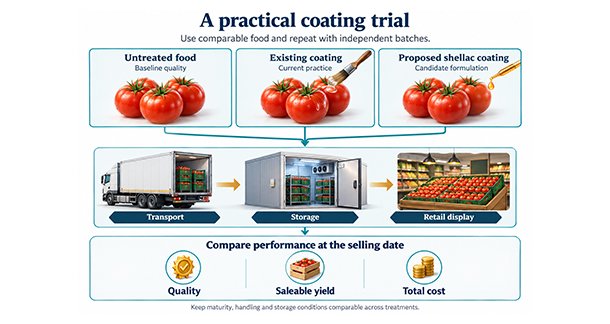
Compare the proposed shellac formulation with untreated food and, where relevant, the coating already used by the business. Use comparable maturity, size and handling. Allocate produce fairly among treatments and repeat the comparison with independent batches on different occasions. This helps distinguish coating performance from variation between consignments.
Follow the expected journey through transport, storage and retail display, including likely temperature changes. Record temperature and relative humidity. Assess quality at planned intervals and at the intended selling date. An improvement seen only under ideal laboratory storage may have little value on a commercial route.
Measure what customers will experience
For fruit, record weight loss, shrivelling, colour, firmness, decay and saleable quantity. Include flavour checks on sound samples: a glossy surface can remain attractive even when gas exchange is unsuitable. For confectionery, examine gloss retention, tackiness, cracking and damage during packing and handling. Record rejection reasons as well as the final quantity accepted.
Keep application records simple enough for routine use. Note the formulation batch, working dilution, quantity consumed, drying time and visible defects. Check packed samples as well as loose ones because contact surfaces and handling can reveal problems missed immediately after drying. Photographs taken under consistent lighting provide a useful record alongside measurements.
Calculate cost through to sale
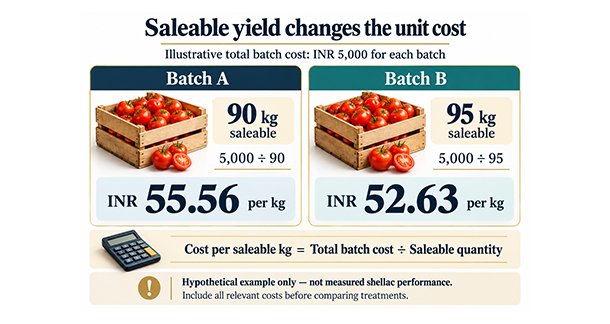
Compare coatings at their actual working dilution and consumption rate. Include incoming food, coating, labour, drying energy, cleaning, packaging and relevant equipment costs. Account consistently for rejected and unsold material. Then divide the total batch cost by the kilograms remaining saleable at the target date. This connects process expenditure with the output that can earn revenue.
For illustration, suppose two comparable batches each cost ₹5,000 in total. If one leaves 90 kg saleable and the other 95 kg, their costs are approximately ₹55.56 and ₹52.63 per saleable kilogram. These are hypothetical figures, not shellac trial results. In practice, any additional coating cost must be included before claiming a saving. A price premium should likewise be supported by actual buyer acceptance.
Measure coating consumption rather than estimating it from the amount initially prepared. Record unused solution, spills and material carried out with the product. A formulation that appears inexpensive per litre may become costly if much is discarded or drying limits the number of batches completed each day. Use the same accounting period for every comparison.
Before buying equipment, repeat the preferred treatment using the packhouse’s available labour and normal batch size. Check whether application and drying fit the daily schedule. If extra space, ventilation or supervision is needed, include it in the decision. A technically effective coating must also fit the business that will use it.
Expand only after repeatable results
A successful trial should lead to a manageable operating procedure. Agree who checks incoming material, prepares the coating, monitors drying and releases the finished batch. Retain supplier and batch records so that a complaint can be traced. Confirm that the same grade can be supplied reliably and that operators can reproduce the approved application.
Shellac comes from insects, which matters to some customers and dietary claims. Review ingredient declarations and proposed claims against applicable rules and buyer requirements. Avoid promising a fixed shelf life across products or seasons. The strongest case for adoption is a documented improvement in acceptable food reaching the customer, supported by repeatable quality and a sound cost calculation.
Selected sources
Food Safety and Standards Authority of India. Food Products Standards and Food Additives Regulations, Appendix A. Current provisions for shellac, bleached (INS 904). https://fssai.gov.in/upload/uploadfiles/files/Appendix%20A%281%29.pdf
EFSA Panel on Food Additives and Flavourings (2024). Re-evaluation of shellac (E 904) as a food additive and a new application on the extension of use of shellac (E 904) in dietary foods for special medical purposes. EFSA Journal, 22, e8897. https://doi.org/10.2903/j.efsa.2024.8897
European Commission (2026). Commission Regulation (EU) 2026/189 of 28 January 2026. https://eur-lex.europa.eu/eli/reg/2026/189/oj
About the authors
Sakharam Kale(Senior Scientist) is affiliated with ICAR-National Institute of Secondary Agriculture, Ranchi. Prerna Nath(Senior Scientist) is affiliated with ICAR-Research Complex for Eastern Region, FSRCHPR, Ranchi.