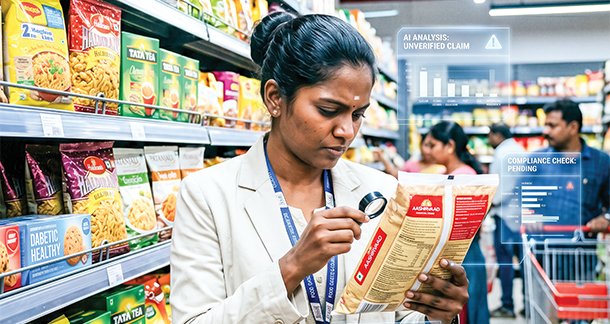
A new industry-led report is prompting critical introspection within India’s packaged food sector. The LabelBlind® Study of Labelling Claims in India’s Packaged Food Industry (Feb 2026) shifts the spotlight from consumers to the industry itself, examining how food labels are created, validated, and presented. Unlike consumer perception studies, this report is designed to strengthen compliance systems, identify structural gaps, and push the industry toward more accountable labelling practices.
At its core, the study is not about calling out brands; rather, it is about course correction. As India’s packaged food market expands rapidly, with thousands of SKUs entering retail shelves each year, labelling has become a critical compliance checkpoint. The report highlights why decoding labels is a strategic necessity for both domestic credibility and global competitiveness.
Why this study matters
The intent behind the study is clear: to draw the attention of food businesses to the increasing complexity and importance of regulatory compliance. Food labels today serve multiple purposes: they inform, market, differentiate, and increasingly, withstand regulatory scrutiny. However, without robust internal validation systems, labels can quickly become points of vulnerability.
By focusing on industry practices, the study highlights operational challenges, ranging from claim substantiation to cross-functional coordination between R&D, marketing, and regulatory teams. It reinforces the idea that compliance cannot be an afterthought added at the packaging stage; it must be embedded into product development itself.
Key findings that are driving debate
The report is grounded in extensive data, analysing 586 products across 227 brands, and evaluating 5,058 on-pack claims. Its findings reveal systemic inconsistencies that are now difficult for the industry to ignore.
- One in three claims raise compliance concerns
A striking 33.6% of all claims were found to be either non-compliant (21.3%) or unverifiable (12.3%). This suggests that a significant proportion of claims lack proper substantiation or fail to meet regulatory requirements. For an industry that relies heavily on front-of-pack communication, this raises concerns around both internal validation processes and regulatory interpretation. - High-consumption categories show higher gaps
The study identifies notable non-compliance levels in everyday food categories such as –
- Snacks:3%
- Flour:8%
- Edible oils:7%
These are staple categories with high consumer reach, making the implications of inaccurate labelling more widespread. For example, a commonly consumed flour product with exaggerated health claims or an edible oil marketed with loosely defined benefits can influence daily dietary choices at scale.
- Health claims are the most vulnerable
Among all claims analysed, 39.1% were health or nutrition-related, making them the most influential and risky category. More concerning is that health claims showed a 52.5% combined rate of non-compliance or unverifiability.
Examples cited in the report include:
- Flour products claiming to “reduce the risk of certain cancers”
- Tea and herbal infusions marketed as “supporting heart health”
- Honey labelled as “good for heart health”
- Ready-to-eat meals positioned as “diabetic friendly”
- Edible oils claiming “hormonal balance”
Such claims, when not scientifically substantiated, can mislead consumers into overestimating a product’s health benefits.

- Claim density is contributing to confusion
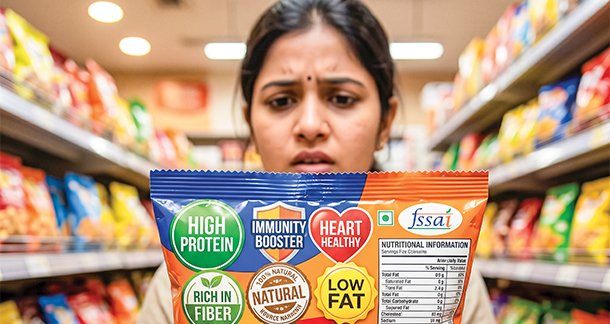
On average, products carried 8.6 claims per pack, with some categories like snacks and honey going up to 13–14 claims per product. This high claim density creates information overload, often leading to conflicting signals between marketing claims and actual nutritional data.
For instance, a snack product may highlight “high protein” on the front while also being high in sodium or saturated fat; details that are less prominently displayed. This imbalance in communication can distort consumer understanding and decision-making.
Compliance gaps point to systemic challenges
The findings suggest that the issue is not merely regulatory gaps but inconsistencies in implementation. Challenges include:
- Lack of standardised interpretation of claim definitions
- Weak internal validation and audit mechanisms
- Limited integration of regulatory checks during product development
These systemic issues indicate that compliance is still treated as a checkpoint when it should be a continuous process embedded across the product lifecycle.
Beyond compliance: A business and public health imperative
The implications of these findings go beyond regulatory risk. Misleading or poorly substantiated claims can shape consumer perception, influence dietary patterns, and ultimately impact public health outcomes, especially in a country like India, which faces a dual burden of undernutrition and lifestyle diseases.
At the same time, the report underscores a critical business reality: global market access increasingly depends on labelling compliance. International regulations vary widely in their requirements for ingredients, allergens, and claims. A product that is non-compliant domestically is unlikely to pass scrutiny in export markets.
The way forward
The debate sparked by this report is already pushing the industry toward more structured solutions. Key areas of focus include:
- Stronger claim validation systems: Integrating scientific substantiation and regulatory checks early in product development.
- Clearer regulatory guidance: Reducing ambiguity in claim definitions and permissible language.
- Digital compliance tools: Leveraging technology and AI to ensure real-time validation and consistency across labels.
- Front-of-Pack Labelling (FOPL): Simplifying key nutritional information to balance marketing claims with factual data.
Ultimately, the responsibility of decoding food labels cannot rest entirely on consumers. As the industry responds to this report, compliance is becoming a defining factor in trust, transparency, and long-term growth.