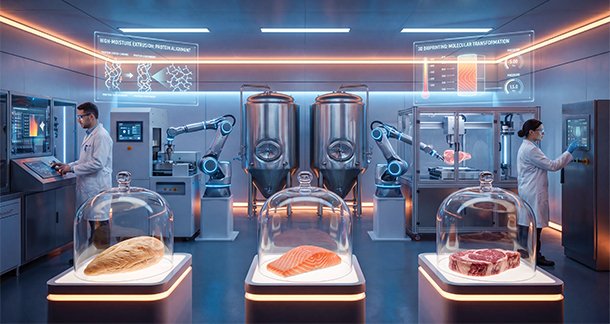
When a consumer bites into a piece of vegan chicken and finds it pulls apart in fibrous strands, or flakes a plant-based salmon fillet onto their pasta, they are experiencing the result of some of the most technically demanding food science on the planet. Creating convincing meat and seafood analogues from plants is not simply a matter of flavouring , it is a deep engineering challenge rooted in physics, chemistry, and materials science. Here is how it is done, and why it is so fundamentally different from conventional food processing.
Why Plant-Based Processing Is Different
Animal muscle is inherently fibrous. Strands of myosin and actin proteins are arranged in long, parallel bundles that give meat its distinctive chew, tear, and bite. Plants contain proteins too , in peas, soy, wheat, and legumes ,but these proteins exist in a globular, compact form. Plant proteins must undergo the processes of unfolding, cross-linking, and aligning to produce the fibrous structure that extends from the microscopic to the macroscopic scale. This transformation does not happen naturally. It must be engineered.
The complex and resource-intensive task of replicating the texture, flavour, and nutritional profile of traditional meat using plant-based ingredients demands specialised equipment, high-quality raw materials, and advanced processing techniques , all of which drive up production costs significantly. It is this gap between a raw pulse and a convincing chicken breast that defines the entire field.
High-Moisture Extrusion: The Engine of Vegan Meat
The most widely used industrial technique is High-Moisture Extrusion Cooking (HMEC). During extrusion, proteins undergo thermal and mechanical stresses through heating of the barrel and shearing of the screws, altering protein structure and leading to the formation of aggregates that create meat-like textures.
What makes the high-moisture variant so critical is precision. HMEC operates at moisture content between 40% and 80%, with an optimal range of around 60%, where moisture acts as both a plasticiser and a solvent, influencing protein mobility, gelation, and product texture. If moisture content is too low, it leads to increased viscosity and hardness; excessive moisture results in significant softening.
Temperature is equally critical. Temperatures above 160°C cause excessive aggregation that negatively impacts sensory attributes, resulting in rubbery textures. Cooling die design , including length-to-diameter ratio and temperature between 20°C and 80°C, also affects the final fibrous structure, with longer dies favouring laminar, pork-like textures and shorter dies simulating chicken-like textures.
This single fact explains why making vegan chicken and vegan pork are not the same process , the physical geometry of the machine itself must be adjusted for each target product.
Shear Cell Technology: Precision Structuring
Where extrusion is industrial and continuous, shear cell technology offers a more controlled alternative. Shear cell technology was developed to impart a well-defined shear, pressure, and heat treatment to protein ingredients. Researchers have created Couette cell devices to produce anisotropic, fibrous meat analogues using formulations of plant proteins in demineralised water.
Shear-induced structuring involves a shear cell designed like a rheometer to apply shear force, offering convenient control due to its simple geometry and just two processing variables ,temperature and shear rate. This makes it a valuable research tool for understanding exactly how fibre formation occurs, even if extrusion remains the dominant method at commercial scale.
The Particular Challenge of Vegan Fish
If vegan chicken is difficult, plant-based fish is harder still. It is hard to achieve the nutritional content, unique textures, and mild flavours of cooked fish meat using vegetables or fungi. Plant-based seafood mimics exist, but their ingredients often don’t include meaningful protein.
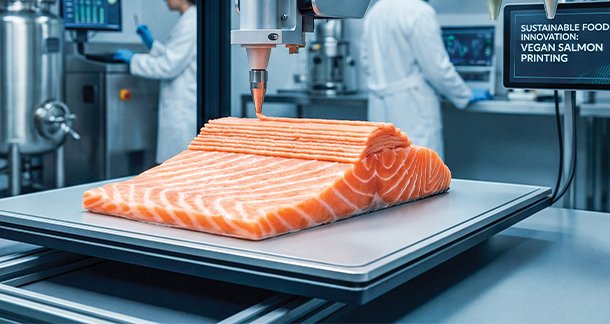
Fish presents unique textural targets: the delicate flakiness of white fish, the layered fattiness of salmon, the springy chew of calamari. These are difficult to replicate with standard extrusion. This is where 3D food printing is stepping in as a genuinely transformative technique. Researchers at the National University of Singapore replicated the flakiness and mouthfeel of real fish by 3D printing a protein-based ink with a food-grade 3D printer, depositing it layer by layer to create different textures , some fatty and smooth, others fibrous and chewy , within a single product.
Commercially, Vienna-based Revo Foods has teamed up with Belgian company Paleo, backed by a €2.2M EU grant, to develop a specially fermented Myoglobin protein, typically found in animal muscle, to enhance the taste, texture, colour, and nutritional value of its 3D-printed salmon alternative, with the company claiming its process cuts water use by 90% and CO₂ emissions by 75%.
Fermentation as a Flavour and Texture Tool
Fermentation is emerging as a critical secondary processing step across all categories of plant-based meat. The incorporation of fermentation in plant-based meat production provides products with better sensorial qualities, addressing one of the most persistent consumer complaints , that vegan meats simply do not taste right. Fermentation can develop depth of flavour, reduce beany or off-notes in legume proteins, and improve mouthfeel in ways that mechanical processing alone cannot achieve.
3D Printing: The Frontier of Whole-Cut Analogues
Standard extrusion excels at grounds, strips, and nuggets, but whole-cut formats — a chicken breast, a salmon steak, a fish fillet , require spatial complexity that extrusion cannot easily deliver. Steakholder Foods has developed a drop-on-demand 3D printing technology that enables ultra-precise deposition of micro-droplets of plant-based materials, allowing for structuring and marbling that replicates the texture and appearance of fish, with products including Beef Steak, White Fish, and Chicken Fillet blends designed to replicate the taste and texture of conventional meat.
The Road Ahead
Innovations in processing techniques are shaping the future of plant-based meat alternatives, and establishing regulatory consensus will be significant in propelling the industry’s development. As techniques like high-moisture extrusion, shear cell structuring, precision fermentation, and 3D bioprinting mature and converge, the gap between plant protein and animal protein , texturally, nutritionally, and sensorially , will continue to close. The science is not just catching up with consumer expectations. In some ways, it is beginning to surpass them.
Sources:
IFT Food Technology Magazine, Wiley / Journal of Food Process Engineering , Taylor & Francis, PMC / Wiley, ScienceDirect / Journal of Future Foods , Food Manufacturing , 3D Printing Industry Vegconomist