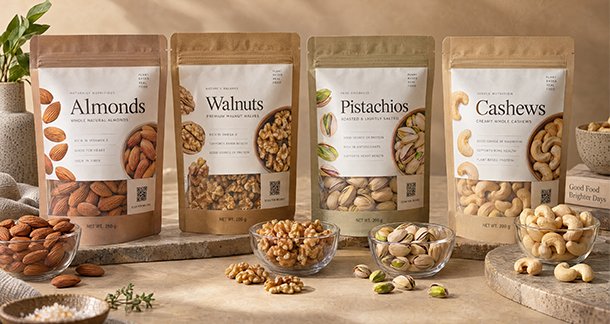
Imagine purchasing a pack of walnuts that protects their delicate fats from oxidation, tells you how to store them, offers a practical serving guide and helps you track freshness—all while reflecting the brand’s commitment to health and sustainability. This is the emerging opportunity in nut packaging: moving beyond containment towards a more intelligent food experience.
Nuts such as almonds, walnuts, pistachios, cashews and peanuts are nutrient-dense foods containing protein, fibre, unsaturated fats, vitamins and minerals. Yet their quality can deteriorate through exposure to oxygen, heat, light and moisture. Packaging therefore has a role that extends beyond appearance. It can help preserve food quality, influence eating habits, communicate nutrition and create commercial value.
From a dietitian’s perspective, the future of nut packaging lies in one compelling idea: packaging should protect what is inside while improving the choices made outside.
- Packaging That Encourages Mindful Eating
Traditional packaging focuses on selling a quantity of nuts. Innovative packaging can focus on helping consumers understand how to enjoy them as part of a balanced diet.
Consider a pack divided into convenient portions, each containing a clearly stated serving suggestion. Instead of encouraging consumers to eat directly from a large family-sized bag, the design can make portion awareness easier without imposing rigid dietary rules.
A QR code could link to evidence-based serving guidance, recipe ideas and nutrition information for different age groups or dietary preferences. For example, consumers could explore ways to incorporate nuts into breakfast bowls, salads, homemade trail mixes or snacks.
Such features should educate rather than prescribe. Individual energy and nutrient requirements differ, and no single serving size suits everyone. The objective is to make informed eating simpler, not to turn packaging into a substitute for professional dietary advice.
- Packaging That Protects Nutritional Value
Nuts contain fats that are susceptible to oxidation. When exposed to oxygen, light and elevated temperatures, they may develop rancid flavours and lose desirable sensory qualities. Packaging design must therefore begin with food science.
High-barrier flexible pouches, airtight containers and appropriately sealed metal or glass packaging can help protect product quality. Vacuum packaging and modified-atmosphere packaging, including nitrogen flushing, may further delay oxidation when suitable for the product.
The next opportunity is intelligent packaging. Research and commercial development are exploring indicators that can communicate aspects of food conditions or exposure to particular environmental changes. In future nut products, carefully validated indicators could help consumers and retailers assess storage conditions more effectively.
However, an important distinction remains: a freshness indicator is not automatically a food-safety test. Any such technology must be validated for the specific product, and visual appearance alone cannot guarantee safety.
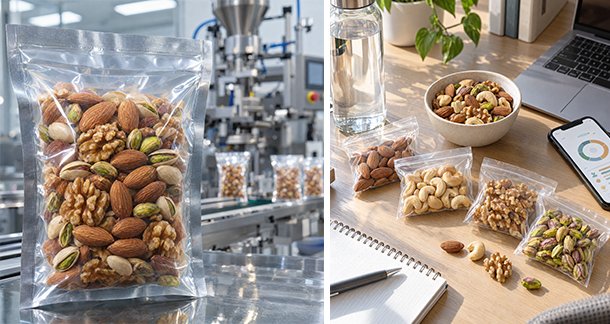
3. Personalized Packaging: One Product, Different Consumer Experiences
Why should every nut product have the same packaging format?
A more consumer-centred approach would match packaging to lifestyle and purchasing behaviour.
- The busy professional: Compact, resealable packs that fit into a work bag.
- The family shopper: Larger packs with secure closures to reduce repeated exposure to air and moisture.
- The fitness enthusiast: Convenient snack portions with transparent nutrition information.
- The premium gift buyer: Reusable-looking presentation containers or carefully designed festive assortments.
- The sustainability-conscious consumer: Packaging designed to minimise unnecessary material and support practical reuse or recycling.
These are not merely different designs; they are different product experiences. Businesses can test which formats customers’ value most before investing in large-scale custom packaging.
4. From Waste to Worth: The Circular Packaging Opportunity
Sustainability is becoming an important consideration in food packaging, but meaningful innovation requires more than replacing plastic with paper.
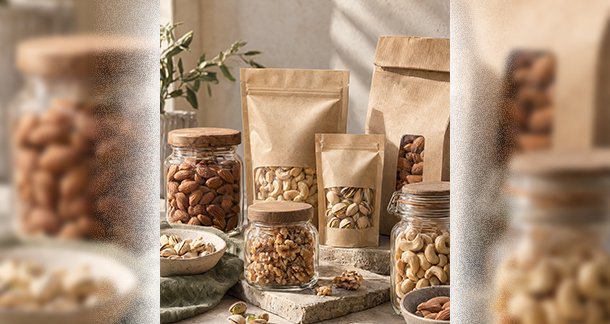
Paper-based materials may need additional barrier layers to protect nuts from oxygen and moisture. Some multilayer flexible packs provide excellent protection but can be difficult to recycle through existing systems. Glass may be reusable but is heavier to transport. Every material present has trade-offs.
A more responsible business approach considers the complete packaging lifecycle: material sourcing, manufacturing, transportation, food protection, re-use and end-of-life disposal.
Brands can explore recyclable mono-material pouches where suitable, right-sized packaging that reduces excess material, and reusable containers designed for repeated use. These options should be assessed against product shelf-life requirements and the availability of local collection or recycling infrastructure.
There is also a financial opportunity. Reducing damaged stock, food spoilage and unnecessary packaging can improve resource efficiency while supporting a credible sustainability message.
5. The Business Innovation: Turning a Nut Pack into a Brand Experience
For emerging food businesses, packaging is often the first physical expression of a brand. But differentiation need not depend on expensive containers or elaborate printing.
A small business could begin with standard food-grade pouches, distinctive labels and a QR code linking to useful nutrition education. As demand grows, it could introduce trial-size packs, festive collections or subscription formats.
A particularly promising concept is the “Know Your Nuts” pack: a package that combines transparent ingredient information, allergen declarations, storage instructions, serving guidance and a digital story about the product’s origin. Such a format gives consumers a reason to engage with the brand beyond the initial purchase.
The business case should be measurable. Brands can compare packaging costs, customer feedback, repeat purchases, product damage, returns and waste before scaling an innovation. Customisation is most valuable when it solves a real problem or improves the customer experience.
Nutrition-led marketing must also remain evidence-based. Claims such as “heart healthy,” “sugar-free” or “high protein” should only be used when the product meets applicable legal requirements. Honest communication builds more lasting trust than exaggerated health promises.
6. The Dietitian’s Vision: Packaging That Communicates, Protects and Empowers
The future of nut packaging will depend on collaboration among dietitians, food scientists, designers, manufacturers and businesses. Dietitians can contribute by evaluating nutrition communication, identifying common consumer misconceptions and developing practical educational content.
Food technologists can validate protective materials and shelf-life performance, while designers can make essential information easier to understand. Businesses can then translate these insights into products that are functional, appealing and commercially viable.
The most meaningful innovation will not necessarily be the most expensive or technologically complex. Sometimes, a clear label, an effective seal, an appropriate portion format and accurate storage guidance can create more value than a complicated design.
Conclusion
Nut packaging is evolving from a protective shell into a potential platform for nutrition education, freshness management, sustainability and brand engagement. Its future lies in combining scientific protection with thoughtful consumer design.
As a dietitian, I see an opportunity to make every pack do more: preserve food quality, communicate honestly and support informed choices. As the food industry explores smarter and more sustainable solutions, the winning package will not simply be the one that attracts attention on a shelf. It will be the one that earns trust long after the package is opened.
By Muskan Ghai
M.Sc. Dietetics & Nutrition