A bright finish can help a food catch the buyer’s eye. Shellac, a refined natural resin, provides that finish on some confectionery and coated produce. It can also help limit moisture loss. For a processor, however, the useful question is whether the coating keeps the food acceptable through storage and sale at a cost the business can afford.
Shellac connects a familiar food technology with lac cultivation in India. Its performance depends on the resin grade, the formulation and the amount deposited on the food. A good coating must dry evenly, withstand handling and preserve eating quality. The shine is only the beginning.
From lac bearing branches to shellac
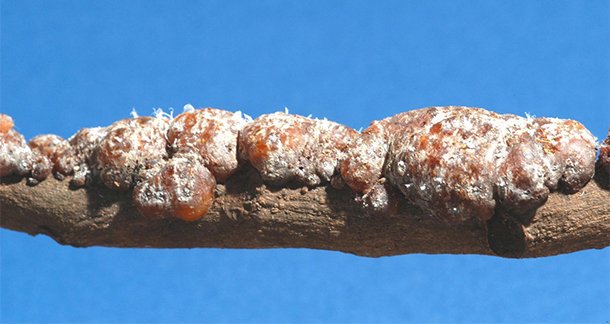
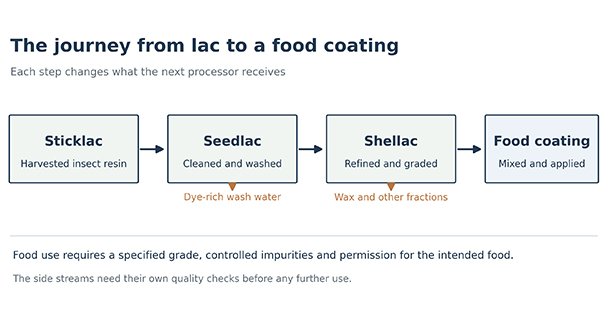
Lac insects, notably Kerria lacca, secrete resin on the twigs of host trees. The harvested material, called sticklac, contains resin together with wax, colouring matter and debris. Crushing, cleaning and washing produce the granular material known as seedlac. Further refining produces shellac. Figure 1 shows the biological source of the resin; Figure 2 outlines the processing stages.
Choose the grade before choosing the recipe
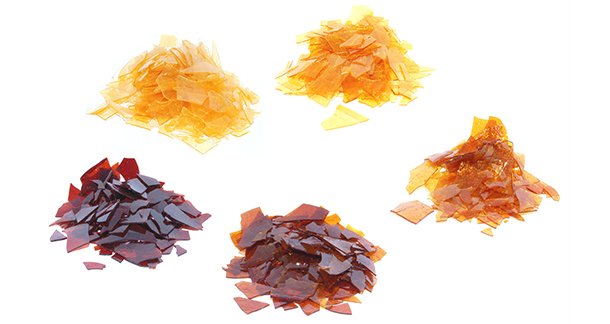
Heat filtration, solvent processing, wax removal and colour removal produce materials with different characteristics. Pale colour can be useful where a clear finish is wanted, but colour alone does not establish purity or suitability for food. The flakes in Figure 3 illustrate visual variation in shellac; they are not evidence that the photographed samples meet food specifications.
A buyer should specify the refining route, wax status, colour, solubility, storage conditions and relevant purity limits. A recent batch certificate should support the specification. Shellac changes during storage and may become harder to dissolve, so age and storage history can affect preparation time and coating consistency. A sample that works well once is not enough to establish a dependable supply.
A film that protects while the fruit breathes
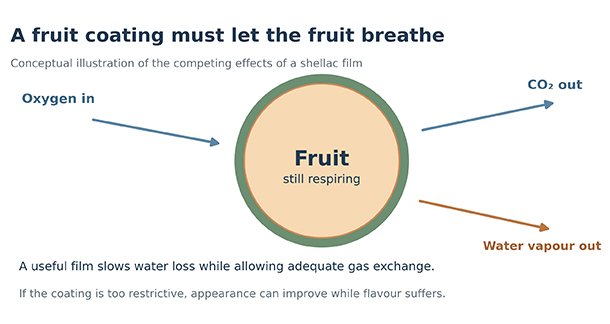
As a coating dries, shellac forms a thin film. On confectionery, the main purpose may be a smooth, glossy surface. On fresh produce, the film also changes the movement of water vapour and respiratory gases. A useful formulation slows moisture loss while allowing enough gas exchange to preserve flavour and normal quality (Figure 4).
Harvested fruit remains alive. If the coating restricts oxygen too severely, fermentation can produce unwanted flavours even while the surface remains attractive. Increasing the shellac concentration or applying a thicker layer may therefore make the result worse. Coating composition and deposited amount must be tested together on the intended commodity.
Formulators may blend shellac with other film-forming ingredients or approved additives to adjust flexibility, wetting and permeability. Each ingredient changes the complete system. A reported benefit from an essential oil or another active component should not be attributed to shellac alone. Any flavour, odour or labelling implications also belong in the assessment.
What research can tell a packer?
Published studies demonstrate useful possibilities rather than a universal shelf-life claim. Chauhan and colleagues (2015) tested shellac with Aloe Vera gel on tomatoes and reported better retention of quality than in untreated fruit. Their work also showed why gas exchange matters: shellac alone could be too restrictive. Soradech and colleagues (2017) studied shellac–gelatine coatings on bananas, providing another example of how blending changes performance. These formulations should not be transferred directly to another fruit or production line without evaluation.
For a commercial decision, compare the proposed formulation with both untreated food and the coating already used by the business. Keep maturity, handling and storage conditions comparable. Weight loss and appearance are useful measurements, but firmness, flavour and saleable yield are equally important. A coating cannot restore damaged fruit or compensate for poor hygiene and unsuitable storage.
Preparing and applying the coating
Shellac is not simply mixed with plain water like sugar. Commercial formulations may use a suitable solvent system or an aqueous system prepared with an appropriate food-use alkali and other ingredients. The complete formulation must meet the requirements for its intended application. For a small packhouse, a documented ready-to-use coating may be a more practical starting point than developing a formulation from raw resin.
Apply the coating to a sound, clean product after removing excess surface water. Dipping, spraying and brushing can leave different amounts on the same food. Record solids content, viscosity, application rate and drying conditions. Check for pooling, patchy coverage, tackiness and whitening after drying and storage. Dipping also requires control of bath cleanliness and carryover between batches. Follow the supplier’s handling instructions, including ventilation and ignition control where an alcohol-based product is used.
Opportunities for rural enterprises
Lac cultivation and primary processing support livelihoods in producing regions, including Jharkhand. Demand for consistent food-use resin could strengthen links between growers, processors and ingredient suppliers. Farmer producer organisations and self-help groups may find opportunities in organised procurement, cleaner primary processing or shared packhouse services. Producing a finished food coating requires additional formulation expertise, quality assurance and reliable market access.
Lac dye and wax may offer additional revenue where recovery and purification are technically and commercially feasible. Wash water and other residues still need proper management. A renewable raw material does not automatically make the entire process low impact: water, energy, refining chemicals, transport and any verified reduction in food loss all matter.
Food-grade shellac is useful when its grade, formulation and application suit the product. A processor can make a sound decision by asking for a documented material, running a realistic comparison and measuring quality and cost through to sale. That is how an attractive finish becomes a worthwhile food technology.
Selected sources
Chauhan, O. P., Nanjappa, C., Ashok, N., Ravi, N., Roopa, N. and Raju, P. S. (2015). Shellac and Aloe Veragel based surface coating for shelf life extension of tomatoes. Journal of Food Science and Technology, 52, 1200–1205. https://doi.org/10.1007/s13197-013-1035-6
Soradech, S., Nunthanid, J., Limmatvapirat, S. and Luangtana-anan, M. (2017). Utilization of shellac and gelatine composite film for coating to extend the shelf life of banana. Food Control, 73, 1310–1317. https://doi.org/10.1016/j.foodcont.2016.10.059
EFSA Panel on Food Additives and Flavourings (2024). Re-evaluation of shellac (E 904) as a food additive and a new application on the extension of use of shellac (E 904) in dietary foods for special medical purposes. EFSA Journal, 22, e8897. https://doi.org/10.2903/j.efsa.2024.8897
Image credits and reuse permissions
- Figure 1 — Jeffrey W. Lotz, Kerria-lacca.jpg. Source: Forestry Images, image 5385241, via Wikimedia Commons. No endorsement is implied. Source: https://commons.wikimedia.org/wiki/File:Kerria-lacca.jpg | Licence: https://creativecommons.org/licenses/by/3.0/
- Figure 3 — Nuberger13, Shellac varities.png (2009), via Wikimedia Commons. Source: https://commons.wikimedia.org/wiki/File:Shellac_varities.png
- Figures 2 and 4 — Original explanatory schematics prepared by authors. Neither is experimental evidence or a measured process balance.
About the authors
Sakharam Kale (Senior Scientist) is affiliated with ICAR-National Institute of Secondary Agriculture, Ranchi. Prerna Nath(Senior Scientist) is affiliated with ICAR-Research Complex for Eastern Region, FSRCHPR, Ranchi.