


Headquartered in Australia, Flavourtech is a world leader in the development, design and manufacture of thin-film, spinning cone technologies for dealcoholisation, aroma recovery, extraction and concentration. Their unique technologies, including the renowned Spinning Cone Column, are benefitting food and beverage manufacturers around the world by enabling them to produce high-quality, specialty products that stand out amongst competitors.
For the last few years, Flavourtech’s engineers have been working on the miniaturisation of its technologies. “Going smaller can be a challenge but the engineering team did a great job in redesigning each system from the ground up,” Director of Sales & Marketing, Paul Ahn, says. “We made these changes after listening to smaller, specialised companies who wanted to enter the market, and having smaller systems would allow them to do that.” Ahn adds that “The plus for universities and research institutes is that these smaller systems are ideal for research projects as well as introducing students to technologies they will use on a larger scale upon joining the workforce.”
Flavourtech’s technologies now available in smaller models include:
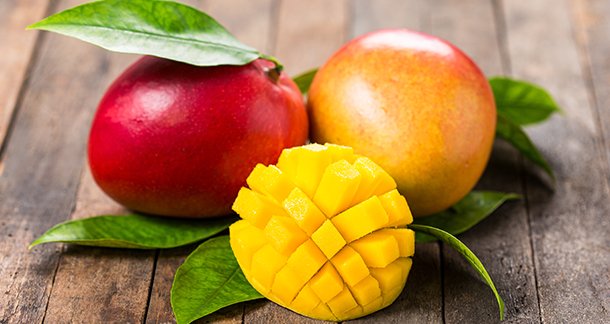
- The Spinning Cone Column (SCC)
The SCC is designed to extract and recover volatile compounds using steam, under vacuum conditions. This is a far gentler process compared to standard extraction techniques, enabling the SCC to better capture aromas and flavours.
Used across multiple industries, applications for the SCC include:
- Aroma recovery during instant coffee production
- Simultaneous flavour and soluble solids extraction for Ready-To-Drink tea/coffee production
- Extraction of natural flavours from fresh fruit
- Essential oil extraction from botanicals, herbs and spices
- Aroma recovery and preservation during production of fruit and vegetable juices/purees
- Dealcoholisation and alcohol management in wine, beer, cider and spirits production
- Deodorisation of cream and flavour management of dairy products
The new smaller model, known as the SCC100, has a throughput of 25-115 L/hr*, making it ideal for universities, R&D departments and small production runs. Three model types are available:
- The SCC100-C : for clarified extracts and juices;
- The SCC100-W : for dealcoholisation of alcoholic beverages; and
- The SCC100-S : for slurry processing that may include coffee, tea, fruit & veg puree/pulp
* Depending on feed product characteristics and applications
- The Centritherm® evaporator
The Centritherm® evaporator is the ideal technology for producing high quality concentrates of products that are heat sensitive, viscous or of particularly high value. With a residence time on the heating surface of only one second, and evaporation temperatures as low as 35oC, the technology has minimal to no effect on colour and active constituents. The low temperatures used also ensure that no heat derived flavours are produced to alter the product’s original flavour. Furthermore, its centrifugal design means it can reach higher concentrations than other evaporators and it is often used as a finisher in the evaporation process to reduce process and energy requirements downstream.
Applications of the Centritherm® evaporator include:
- High quality tea and coffee concentrates
- High quality fruit and vegetable concentrates
- Solvent removal from botanicals and oleoresins
- Solvent removal in the pharmaceutical industry
- Concentration of vitamins, enzymes and active ingredients
This thin-film evaporator is also available in a small-scale model, known as the CT1, which has an evaporation capacity of 50kg/hr* making it suitable for universities and research institutes.
* Depending on feed product characteristics and applications
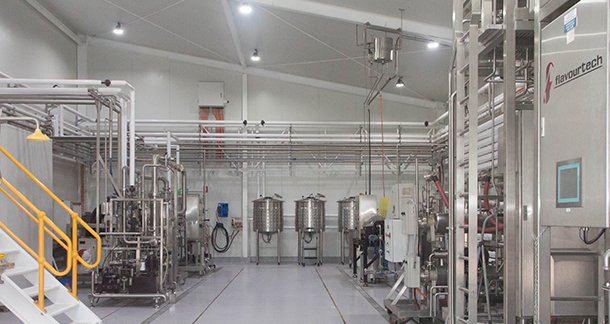
- The Resin Adsorption Column (RAC)
With the growing interest in zero alcohol beverages, Flavourtech has developed the Resin Adsorbing Column (RAC). This technology has at its core, the principles of adsorption and desorption, and can be positioned downstream of the SCC to create a flavoursome no alcohol beverage without the need to add external flavours.
Flavourtech’s engineers have also recently miniaturised their RAC technology, resulting in the smaller RAC1, which is perfectly suited to work with the SCC100-W. This combination is proving ideal for wine or beer research institutes working on zero alcohol projects.
India’s universities and research institutes can greatly benefit from these recently developed models as they are compact, easy to use and have the ability to process multiple products. Potential clients are welcome to make use of Flavourtech’s pilot plant facilities in Australia; Wageningen University in the Netherlands; Kansas City in the USA; and Highfield Tea in Bangalore. These locations each house their state-of-the-art processing technologies and offer paid trials for demonstration of process performance, validation of new product concepts, and formulation optimisation. To book a trial at one of these facilities, please contact sales@flavourtech.com, or visit www.flavourtech.com for more information.
Ultimately, Flavourtech’s small-scale systems are helping to bridge academic research and real-world commercial applications, empowering the next generation of food scientists to develop superior, high-value products.

