

What happens after you‘ve returned your bottle?
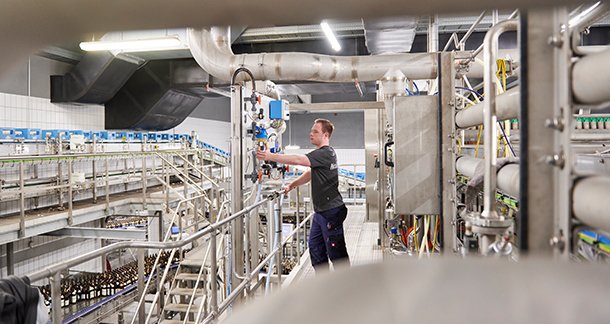
A deposit bottle is usually cleaned, disinfected and refilled around thirty, up to fifty times. One such bottle washing system is located at Maisel‘s brewery in Bayreuth, Germany. The disinfection panel installed there not only provides precise measured values, but also controls the optimum disinfectant dosage.
Challenge
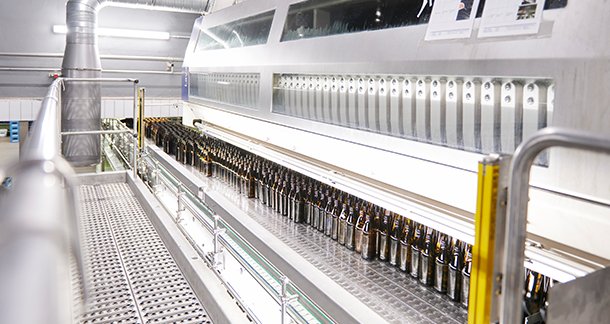
The cleaning process begins with the bottles being emptied of residue, pre-soaked and flushed out. They are then cleaned in alkaline solutions and water baths, disinfected with chlorine dioxide and finally rinsed. The challenge here is to dose enough chlorine dioxide to guarantee reliable disinfection. And at the same time keep the concentration low enough to save costs and protect the system from corrosion.
Typical process challenges – especially all kinds of fluctuations – make chlorine dioxide measurement considerably more difficult. The ancient wisdom of Heraclitus – “nothing is as constant as change“ – applies in a particular way: In the form of temperature fluctuations, fluctuations in flow velocity and irregular downtimes (for example, due to maintenance and washing cycles). In addition, short-term pressure peaks pose a risk of damage to the diaphragm cap. And there is something else that favors incorrect measured values: The high dirt load in the medium. This means that the washing liquid usually contains a lot of label residue, which contaminates the sensor diaphragm.
Measured values are the basis for the dosage. If they are incorrect, the chlorine dioxide concentration will be too high or too low. This not only results in high costs, but also puts people and machines at risk.
“We were only able to develop this panel solution together because we all pulled together as partners. We have always believed in Endress+Hauser and have been very satisfied for years. I don‘t think it‘s an exaggeration to say that we now have the most stable measurement and control system in the industry,“ says Hannes Kauper Head of Filling and Brewing Technology Maisel Bros. Brewery.
Solution
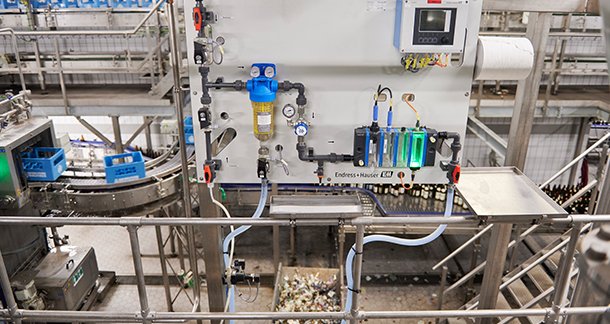
In 2024, Brauerei Gebr. Maisel, together with Endress+Hauser, dev-eloped and installed a panel solution that makes the measuring completely self-sufficient and independent of these challenges. The result is a stable, low-maintenance and reliable disinfection measurement system that enables optimum dosage and works as follows:
- Rinse water
- Sample water
- T he upstream filter effectively protects the sensor from contamination and filters out all label residues. It is automatically backwashed every two hours via a fresh water valve (1) controlled by the transmitter.
- T he pressure regulator limits the pressure so that the sensor diaphragm does not rupture due to overpressure or underpressure.
- The Flowfit CYA27 flow assembly for multi-parameter measurements with the chlorine dioxide sensor and flow measurement ensure a constantly sufficient flow for precise measurement.
- The Liquiline transmitter not only supplies the measured value, but also enables the panel with its control engineering to become a complete solution.
In the panel itself, the transmitter controls the opening and closing of the flush and sample water valves, depending on whether measuring or flushing is taking place.
In the process, it controls the dosing pump and thus enables chlorine dioxide dosing – optimized for the various operating modes (e.g. start-up, washing, rinsing, emptying or draining).
For example, the programmed solution uses the math module to regulate the dosage
Benefits: Safety and savings thanks to process optimization In contrast to pure inline measurement, the panel solution compensates for the typical process challenges described above. This ensures a reliable measured value and a stable process. This means that the optimum dosage can not only be determined, but also implemented directly by the control system. This safely disinfects the bottles, prevents corrosion damage in the plant and saves costs:
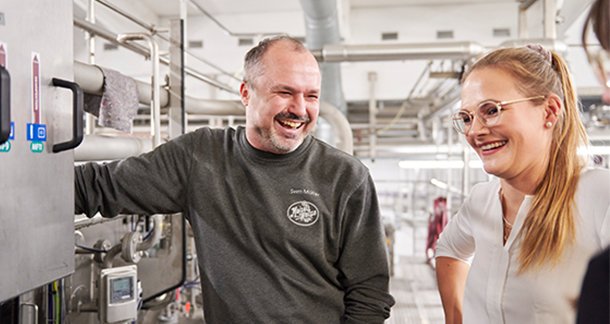
“Thanks to the stable measurement, we were able to reduce the target concentration and save a total of 35% chlorine dioxide.“ Sven Müller, Deputy Head of Filling Maisel Bros. Brewery
Maintenance optimization
This all-inclusive package and the stable conditions on the panel reduce the maintenance effort by automatically cleaning the measuring point. It improves workplace safety and eliminates the need for frequent manual rinsing. The solution enables employees without programming knowledge to set controls such as flush cycles on the Liquiline transmitter themselves. In addition, the brewery‘s calibration data shows that there was no sensor drift within six months. This meant that no adjustment was necessary and the maintenance interval of the sensor was significantly extended. FMT
For more information:
www.endress.com/food-beverage

