
Yash Nawale, Priyanka & P. Barnwal
Dairy Engineering Division, ICAR–National Dairy Research Institute, Karnal–132001
Email: rnakj1992@gmail.com
Introduction
Microwave energy has emerged as a powerful tool in modern food processing, changing the way we cook, preserve, and package food. What began as an innovation for home kitchens is now driving large-scale industrial applications—from drying fruits to sterilizing ready-to-eat meals. With rising demand for nutritious, minimally processed foods, microwave processing offers a perfect balance of speed, safety, and sustainability.
The Science of Microwaves
Microwaves are electromagnetic waves, typically operating between 300 MHz and 300 GHz. In food processing, the most common frequencies are 2.45 GHz (for domestic and pilot-scale use) and 915 MHz (for industrial operations). When microwaves interact with polar molecules such as water or fat, they cause them to oscillate rapidly, producing heat through molecular friction. This volumetric heating ensures that food warms evenly throughout—unlike conventional methods that heat from the surface inward.
Industrial Applications of Microwave Technology
- Drying and Dehydration
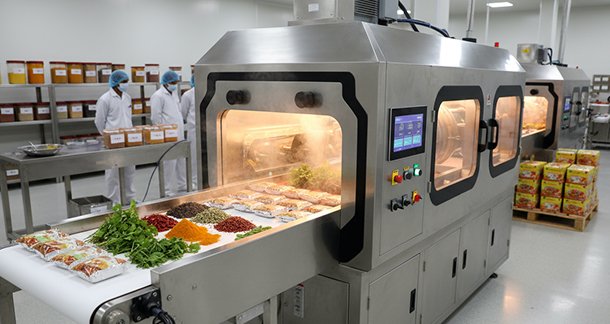
Microwave drying drastically shortens drying time and reduces energy consumption. It helps preserve natural color, aroma, and nutrients in foods such as fruits, vegetables, herbs, and spices. Advanced systems combine microwaves with vacuum or infrared heating to achieve high-quality dried products. For example, microwave–vacuum drying is used for heat-sensitive foods like strawberries and mint leaves.
- Heating and Cooking
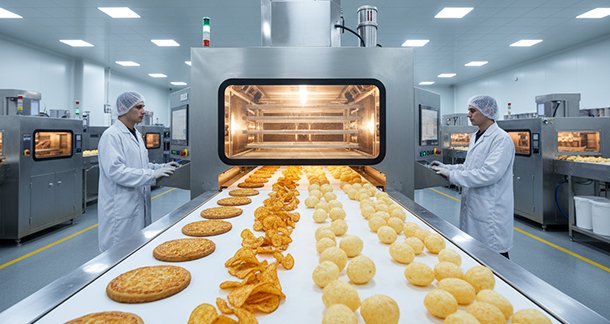
In industrial kitchens, microwaves allow rapid cooking of convenience foods while retaining moisture and flavor. Compared to boiling or frying, microwave cooking minimizes nutrient loss and oxidation. Modern food plants use conveyor-based microwave tunnels for baking cakes, reheating ready-to-eat meals, and preparing snack foods.
- Pasteurization and Sterilization
Microwave-assisted pasteurization and sterilization have become vital for ensuring food safety. These systems can heat foods in sealed containers, maintaining sterility without affecting texture or color. Continuous-flow microwave sterilizers are now used for soups, sauces, milk, and baby foods. The technology reduces processing time by up to 80% while saving significant amounts of water and energy.
- Thawing and Tempering
Microwave thawing provides fast, uniform defrosting of frozen meat, poultry, and seafood. It minimizes drip loss and prevents microbial growth. Large meat processing units employ this technology before grinding or cutting operations, ensuring consistent product quality.
- Blanching and Puffing
Microwave blanching quickly inactivates enzymes in vegetables like peas and spinach, preserving their green color and crunch. In snack production, microwave puffing generates light, crispy textures in cereals and extruded snacks.
Sustainability and Energy Efficiency
Microwave systems are far more efficient than traditional steam-based methods, which often operate below 20% efficiency. Since microwaves generate heat only within the food, there is minimal energy loss. Moreover, microwave plants can operate on renewable electricity, eliminating the need for fossil-fuel boilers. These systems also require less water, making them ideal for sustainable and eco-conscious food production.
Modern Microwave Equipment and Indian Developments
India has been quick to adopt microwave technology for food processing. Several national and international players are contributing to this shift:
- SAIREM (France) and Ferrite (USA) supply advanced microwave dryers and sterilizers for spice and ready-meal industries in India.
- Püschner (Germany) and Ampleon (Netherlands) have collaborated with Indian firms to install continuous-flow microwave heating systems for dairy and beverage processing.
- Indian manufacturers such as Asha Microwave Technologies and Sairem India Pvt. Ltd. provide microwave dryers for spices, dairy powders, and herbal products.
- Research institutions like ICAR–NDRI and CFTRI Mysuru are developing hybrid microwave–infrared and microwave–vacuum systems for milk pasteurization, curd drying, and ghee clarification.
- Startups and automation firms are introducing AI-based microwave dryers and sensors that adjust energy levels dynamically for optimized drying.
Expanding Applications Across Food Categories
- Fruits and Vegetables: Used for drying, blanching, and pasteurization while preserving nutrients and color.
- Meat and Seafood: Rapid, uniform cooking and thawing minimize bacterial growth.
- Dairy and Beverages: Continuous-flow microwave systems for milk, soups, and juices ensure microbial safety with minimal thermal damage.
- Bakery and Snacks: Microwave baking and puffing provide faster production cycles and improved crispness.
Challenges and the Road Ahead
Although microwave processing offers many benefits, challenges remain—particularly in achieving perfect uniformity in large-scale systems and developing microwave-compatible packaging. However, with ongoing research and AI-driven power control, these limitations are being rapidly overcome. The integration of hybrid systems (microwave with radio-frequency or infrared) holds promise for even greater efficiency and precision.
Conclusion
From speeding up drying and cooking to ensuring safer, more sustainable food production, microwaves have revolutionized the food industry. In India, their adoption across dairy, meat, and fruit sectors is a testament to how science can power innovation. As equipment advances and costs drop, microwave technology is poised to become a cornerstone of modern, eco-friendly food processing.
References
Guo, Q., Sun, D.-W., Cheng, J.-H., & Han, Z. (2017). Microwave processing techniques and their recent applications in the food industry. Trends in Food Science & Technology, 67, 236–247.
Bhunia, K., Tang, J., & Sablani, S. S. (2024). Microwave-based sustainable in-container thermal pasteurization and sterilization technologies for foods. Sustainable Food Technology, 2, 926–944.
Guzik, P., Kulawik, P., Zając, M., & Migdał, W. (2022). Microwave applications in the food industry: An overview of recent developments. Critical Reviews in Food Science and Nutrition, 62(29), 7989–8008.
Salazar-González, C., San Martín-González, M. F., López-Malo, A., & Sosa-Morales, M. E. (2012). Recent studies related to microwave processing of fluid foods. Food and Bioprocess Technology, 5(1), 31–46.

