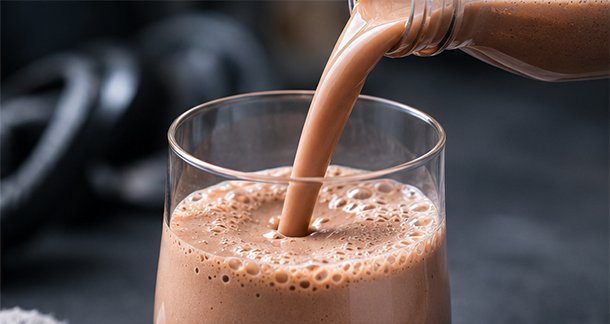
Due to the increasing interest in health, fitness, and nutritious drinks, consumers have become more interested in ready-to-drink (RTD) protein drinks. While protein drinks were once considered the drinks only used by athletes and fitness enthusiasts, there has been increased interest in protein drinks from people who are not involved in any form of exercise due to convenience in meeting their nutritional requirements.
Developing a quality RTD protein drink is not an easy task as there are some processing challenges that need to be addressed in order to make sure that the drink will stay stable, retain a good texture, and provide a pleasant taste over the desired period of storage.
These processing challenges include protein stability, sedimentation, and texture management.
Understanding Protein Stability in Liquid Formulations
Stability of protein molecules plays a key role in RTD beverage production.In contrast to powdered protein supplementation products, RTD beverages should possess stable physical and chemical property in terms of processing, storage and transportation.
Proteins are sensitive to temperature, acidity, mineral content and processing methods. They may undergo structural changes as well as interaction and, as a consequence, aggregation, precipitation and viscosity changes.
Heat processing is especially important for RTD beverages. Producers usually apply thermal treatment to reach the necessary level of microbiological safety and shelf life of their product. Nevertheless, heat processing leads to the unfolding of certain proteins and their interaction with other molecules that cause unwanted beverage changes.
The degree of these changes depends on the type of protein used, formula and processing conditions. Whey proteins, casein-based ingredients and vegetable proteins react differently to heat processing and various pH levels.
Consequently, producers should choose appropriate proteins and process the beverage properly.
Sedimentation: A Persistent Manufacturing Challenge
Another problem associated with protein beverages is sedimentation, which is caused by the formation of insoluble particles or protein aggregates and leads to uneven distribution of ingredients at the bottom of the container.
Even in cases when beverages are meant to be mixed before use, excessive sedimentation can still cause certain problems in consumer’s perception of the product.
There are multiple factors influencing the process of sedimentation, such as particle size, solubility of proteins, viscosity of the beverage and interaction between proteins and other ingredients used in the mixture.
Problems associated with sedimentation can be solved through careful choice of the ingredients, management of particle size, homogenisation and proper stabilisation of the drink.
Homogenisation can positively affect the process of dispersing of the ingredients and reduction of particle or drop size. However, the effect of homogenisation is dependent on the type of the formula and, if misused, can lead to other problems.
Stabilisers and hydrocolloids canalso be used for the purpose of improving suspension and preventing separation of the ingredients. Choice of these ingredients should be made carefully since they affect other properties of the beverage, such as thickness and mouth feel.
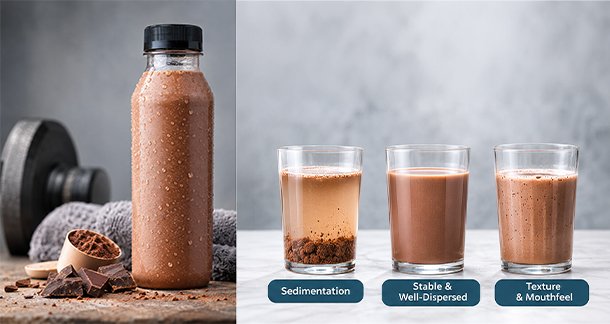
Texture and Mouthfeel: Balancing Nutrition with Consumer Experience
Texture also plays an equally vital role in the performance of RTD protein beverages. Protein beverages are being demanded to have the same level of pleasant texture and drinking experience by consumers, similar to that offered by normal flavoured milk, shakes, or other packaged beverages.
Nevertheless, high levels of protein can affect achieving the right texture.
Due to the nature of ingredients used, the beverage can be very thick, have a grainy texture, be chalky and sometimes astringent. This would result in reduced acceptance from consumers despite meeting the nutrition requirements.
The type of protein used has a great influence on texture. Different proteins vary in their solubility, particle characteristics, and reaction to other ingredients.
Plant proteins, for instance, require formulation adjustment to control insolubility, flavours, and texture, among others. Similarly, dairy formulations are not always easy to formulate, especially where heat treatment is involved or when the protein concentration is increased.
Manufacturers thus need to balance the protein content, viscosity and sensory properties of protein beverages.
The Role of Processing Technology and Ingredient Innovation
The advancement in food processing technologies has presented possibilities for optimising the stability and sensory properties of protein beverages.
Protein beverages formulated using appropriate technologies like high-pressure homogenisation, controlled thermal processing, and specialised protein ingredients can benefit from enhanced stability.
On the other hand, innovative ingredients will be critical for improving the dispersibility, solubility, and functionality of the protein ingredients needed in various applications.
Manufacturers have to consider how to utilise the required emulsifiers and stabilisers without making the formula overly complicated.
Formulas offering both functional attributes and simplified ingredients are increasingly becoming desirable.
It is, however, necessary to consider that simplifying the formulation process might result in new technical hurdles.
Manufacturers must ensure that the modifications made for simplification do not compromise on either the stability or sensory properties of the formula.
Shelf-Life Testing and Quality Consistency
Product quality after the manufacturing process is another critical issue.
The RTD protein drinks will encounter different temperatures and handling procedures during the transport and storage process. This will affect the interaction between proteins and physical separation of proteins and texture change.
It is important that shelf-life testingnot only involves the safety of the product but also includes sedimentation, viscosity, taste, appearance, and other quality parameters.
Accelerated stability testing is important for identifying the formulation challenges, but this should be backed up with the right real-time stability tests.
Quality control is as important during the production process. Small changes in the ingredient properties or the processing procedure will have an impact on the final product.
The Road Ahead for RTD Protein Beverages
With continued development in the convenient nutrition market space, there is an expectation that consumers will start giving more weight to nutritional value, convenience and palatability of products.
This translates to the fact that in the industry, the amount of protein is not the only determining factor of the success of such products.
More collaboration will be necessary between raw material suppliers, technologists and processors to ensure the development of formulations which can consistently meet their performance criteria during production and storage.
The future of RTD protein drinks is in the hands of the industry players’ ability to strike a balance between nutritional value and processing.
Consistency and appeal should be key attributes for successful innovation in the sector.