Introduction
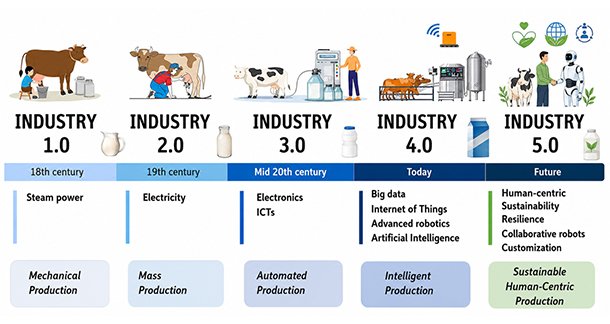
From the beginning, the dairy industry has progressed from rudimentary practices to highly sophisticated techniques of production. Throughout the centuries, technological advances have occurred in practically all areas of dairy production, including milking, processing, milk handling, packaging, and distribution. Similarly, the phases of industrialisation correspond closely to the major changes in the dairy industry. Thus, the first phase is associated with the introduction of mechanisation. The second phase is linked with the use of electricity and mass production processes. The third phase introduced electronics and automation, and the fourth phase is related to connectivity and smart technologies. Finally, the fifth phase emphasises people, sustainability, and resilience.
Each phase of the industrialisation of the dairy industry is characterised by distinct features that distinguish it from the previous one. Understanding each phase can help explain the current state of the industry and anticipate future changes.
Dairy 1.0: The Beginning of Mechanisation
The first phase of the industrialisation of the dairy industry is known as the First Industrial Revolution. It is historically associated with the introduction of steam and water power into the industry. Such means as steam-powered equipment, mechanical pumps, and churns replaced manual labour and led to more efficient processing. For instance, in 1878, Gustaf de Laval and Oskar Lamm invented a new method of centrifugal cream separation. The technique was significantly more efficient compared to traditional gravity separation. Thus, the industry started shifting from being highly fragmented to large-scale production.
While Dairy 1.0 can be associated with the increased efficiency of processing, it still entails the need for substantial human intervention. Processing still required significant amounts of manual labour, while poor refrigeration methods led to products going bad. Moreover, reliance on coal and steam resulted in higher energy consumption as well as safety and environmental hazards.
Dairy 2.0: Electricity, Refrigeration, and Mass Production
The second phase of industrialisation is characterised by the introduction of electricity, refrigeration, pasteurisation, homogenisation, and mass production. In Dairy 2.0, electrical motors improved the efficiency of mechanisms and ensured precise control of processes. At the same time, mechanical refrigeration improved the storage of products. For instance, pasteurisation, a process of heating milk to kill bacteria, increased the safety of products. Similarly, homogenisation ensured that milk was more consistent in flavour and texture. Overall, electrical appliances ensured that the process of dairy production became standardised, automated, and occurred on a larger scale. However, Dairy 2.0 requires a significant amount of capital, access to electricity, infrastructure, and skilled workers. Moreover, large-scale dairy production also requires more resources and results in higher energy consumption.
Dairy 3.0: Electronics and Automation
With the advent of the third industrial revolution, electronics and automation were introduced into the dairy industry. Electronic devices such as sensors, computers, programmable logic controllers, digital instrumentation, and supervisory control and data acquisition enabled better control of the processes and the overall system. For example, sensors were used to measure pressure, temperature, flow rate, and level. The data was then analysed by PLCs that controlled pumps, valves, motors, and heaters. Additionally, such systems included logic that allowed the processes to be automated. Moreover, the use of SCADA allowed the operators to monitor the processes and store data in databases for future analysis. Thus, the use of electronics in the dairy industry increased its efficiency, traceability, and reliability. Sensors allowed for automated and standardised cleaning, packaging, and overall processes of production. Additionally, electronic devices allowed for more efficient milking technologies. Finally, computer logic enabled the development of rule-based systems that formed the foundation of the subsequent phase of Industry 4.0.
Dairy 4.0: The Smart Dairy
Industry 4.0 is characterised by the introduction of artificial intelligence (AI), internet of things (IoT), Big Data, cloud computing, robotics, blockchain, and cyber-physical systems. Thus, the major difference between Dairy 4.0 and previous industries is the increased use of data for decision-making and operations. Specifically, AI and machine learning can be used to analyse data, determine the characteristics of a product, determine its adulteration and defects, and optimise various processes such as pasteurisation, fermentation, and the prediction of shelf life and yield. Moreover, AI can be used for quality assessment, maintenance scheduling, and predictive analytics.
IoT enables the dairy farm to be monitored, controlled, and optimised in real-time. It also improves cleaning, tracking, equipment management, cold chain, and digital traceability. Cloud computing and Big Data are essential for processing the vast amounts of data and deriving meaningful information from it. Moreover, robotics can be used in various applications, including packaging. Finally, blockchain ensures traceability and transparency of the dairy supply chain, although it does not guarantee product authenticity. Overall, the increased use of data in the fourth industry ensures that processes are monitored and controlled continuously.
Dairy 5.0: Human-Centric, Sustainable, and Resilient Dairy
Industry 5.0 represents a new paradigm in which people take centre stage, and technology converges with people and the environment. In other words, while the previous phases of the industry can be characterised by the replacement of humans with machines or the introduction of a particular technological advancement, Industry 5.0 is about working in synergy with people. For instance, cobots allow people to do more complex tasks, while robots handle the monotonous ones. Similarly, digital twins, a virtual representation of a physical entity, can be used to optimize the performance of a system. Thus, the integration of advanced technologies into the dairy industry can help it become more agile and efficient, and ensure that the system is fit for purpose and people are at the forefront. The most relevant technologies include artificial intelligence, IoT, digital twins, edge and fog computing, and collaborative robots.
Challenges and Future Outlook
Smart dairy technologies face several challenges, including high costs, a shortage of skilled workers, inadequate infrastructure, cyber security threats, difficulties with integration and interoperability, regulations, and data challenges. Thus, while the use of smart technologies in the dairy industry is advantageous, it requires people and organizations to modify their behaviours and operate within the new framework, which can be challenging. Sustainability is an essential aspect of the dairy industry that will continue to play a critical role in the future. Although the application of technology can help optimize the use of resources and reduce waste, it is a people-centeredendeavor and, therefore, requires organizational changes and stakeholder engagement. The next-generation dairy factory will see the convergence of sensors, IoT, AI, cloud and edge computing, robotics, and digital twin, as well as traceability technologies.
Reference
- Cabrera, V. E. (2024). Artificial intelligence applied to dairy science: Insights from the Dairy Brain Initiative. Animal Frontiers, 14(6), 60-63.
- Hassoun, A., et al. (2023). Birth of dairy 4.0: Opportunities and challenges in adoption of fourth industrial revolution technologies in the production of milk and its derivatives. Current Research in Food Science, 7, 100535.
- Malik, A., &Panghal, A. (2026). Reviewing the transition from Industry 1.0 to Industry 5.0 in the food processing industry. International Journal of Agriculture Extension and Social Development, 9(5), 108-119.
Anjana Sinha, Priyanka & P. Barnwal
Dairy Engineering Division, ICAR-National Dairy Research Institute,
Karnal-132001, Email: rnakj1992@gmail.com