Packaging can reveal its contents in many ways. Shape and color are just as important for communication as are labels or imprints. The issue of whether product information should be affixed to the packaging material or not has more than only aesthetic implications. The EU Packaging and Packaging Waste Regulation stipulates stringent requirements for future packaging – with indirect consequences for its marking.
For manufacturers, this entails selecting the most suitable option from several alternatives – in line with the product, packaging, available investment funds and the current legal framework. Among its other requirements, the EU‘s Packaging & Packaging Waste Regulation (PPWR) sets high standards for marking and labelling that manufacturers need to comply with from 2026 onwards. From the first year of the regulation‘s application, batch and serial numbers as well as the manufacturer‘s contact details will be mandatory on packaging. In the same year, QR codes or other digital information carriers will be required to provide information on recyclability. This may include information on the recycling process, repair and return systems. As of 2028, standardised pictograms will be introduced across the EU to provide information on material composition.1
The PPWR‘s requirement to develop packaging that is as recyclable as possible remains unaffected. While manufacturers can opt for monomaterials, reduced hot glue quantities or higher recycled content, for instance, they have entirely different levers at their disposal when it comes to marking. These vary depending on the packaging material, production speeds and depth of information. What they have in common is a move away from the classic label, which is viewed critically from a PPWR perspective unless it is also made of monomaterials – and is therefore easy to recycle.
Potential beyond the label
“There are many approaches that can be used for PPWR-compliant marking, all of which can be implemented using printing technologies,” highlights Stefan Horvath, Product Manager at Gerhard Schubert GmbH’s Packaging Competence Centre. In particular, QR or 2D barcodes on packaging are likely to play a greater role in the future, as the PPWR calls for transparency in packaging material recycling. This also includes the Digital Product Passport (DPP), which is set to become mandatory for the first product groups starting in 2027 as a key element of EU circular transparency.
The DPP is intended to give consumers, recyclers, manufacturers and authorities access to reliable data on the composition, origin and processability of the materials used in a given type of packaging. For recyclers, for example, this could simplify the manual sorting of plastics thanks to improved material recognition. However, this advance information is so comprehensive that it cannot be printed on the packaging itself, but is available on external sources such as websites. The codes mentioned above act as an interface to the outsourced information.
Printing instead of gluing
But how do the digital data carriers get onto the packaging? Codes can provide information on sorting or disposal without taking up much space on the packaging. However, additional product or Horvath. However, when lasers are used to apply important information to packaging, manufacturers face new challenges: lasers generally only work on printed films because they either remove material or cause a colour change. In addition to higher investment and operating costs, laser systems also raise safety-related questions: “Protective devices and trained personnel for operation and maintenance are essential for the proper use of a laser system,” explains Horvath. The decision for or against the technology therefore depends on the infrastructure, investment capacity, personnel – and, finally, the product portfolio. “Those who market premium products may be more likely to opt for this variant than manufacturers of fas -moving consumer goods due to the higher resolution of laser printing.”
Using light to create permanent ink
Laser processes enable printed packaging materials to be marked gently, thereby preserving their barrier properties. UV lasers, for example, cause a colour change in existing pigments within the packaging material, which produces the necessary contrast for legible lettering. Unlike CO₂ or fibre lasers, the energy in UV lasers has a photochemical effect. UV lasers can process even thin films, paper or composite materials without melting or burning them.
However, even with an ink-based process, razor-sharp markings can be achieved, including on transparent packaging materials: UV-curing ink enables high printing speeds and delivers excellent print quality, again packaging data required by regulations often means increased development costs, as conventional printing technology such as continuous inkjet (CIJ) is not always suitable.
“In terms of quality and efficiency, laser-based systems offer a clear advantage because they work faster and cover larger areas,” says without compromising the integrity of the packaging material. The process cures liquid UV ink in seconds using light and, due to its high processing speed, is ideal for high-throughput packaging systems. Since the ink does not soak in or evaporate as it does with continuous inkjet printing, the result remains high-contrast and does not smudge, even in high-humidity production environments.
A targeted surface treatment ensures that the ink adheres to the substrate or film, allowing it to be printed on almost any medium. Corona or plasma treatments modify the surface using an electrical charge so that the ink, in the form of tiny balls, does not roll off the material and smudge. “This results in an extremely strong bond with the substrate, a razor-sharp print image and very high scratch resistance,” explains Horvath. However, the technical effort involved is greater than with continuous inkjet systems. UV printing requires special lamps, cooling devices and the right safety measures to protect against UV radiation, among other things. In return, QR and other codes of variable sizes can be applied, regardless of the surface of the material. UV-curing ink enables high-quality printing on infusion bags, as well as on paper, cardboard, glass or metal.
The economical inkjet option
On the other hand, continuous inkjet printing is much less expensive, both in terms of purchase price and ongoing operation. With CIJ, ink is applied through small nozzles in the print head onto absorbent substrates such as paper or cardboard. The technology has even proven itself on smooth surfaces such as films, provided that a solvent is added to the ink beforehand to make it adhere more easily. After application, the solvent evaporates through ambient air, heat or fans – and the ink dries.
It also absorbs into absorbent materials. However, it can smudge because drying by evaporation takes time – and the ink can be subject to external influences before it dries. “This simple and cost-effective process is suitable wherever high printing speeds, low resolution and small print areas characterise the printing operation,” states Horvath. As with the other processes, the packaging in this case does not require a label – another significant step towards alternative marking methods.
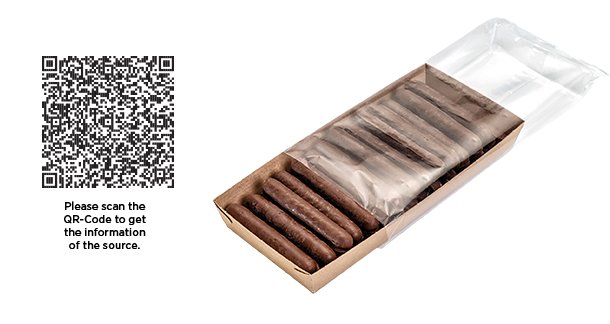
Please scan the QR-Code to get the information of the source.
For more information:
www.schubert.group