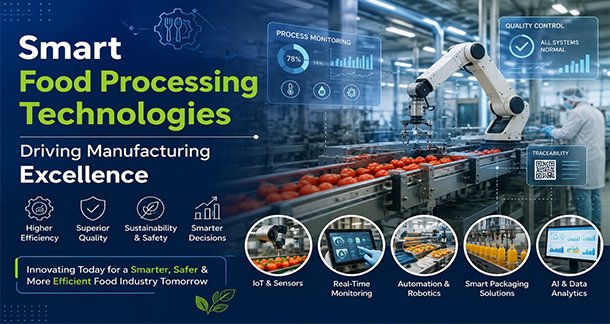
The Evolution of Smart Food Processing Manufacturing
The food processing sector has been witnessing major transformations as food producers incorporate more smart technologies in order to increase productivity, ensure the high quality of products and increase operational efficiency. Food processing through traditional technology is quite often manual and requires fixed schedules and regular quality control, which may be inconsistent, cause the need for extra manpower and may result in wasting some materials.
Smart food processing incorporates automation, artificial intelligence, the IoT, robots, sensors and data analytics in food manufacturing processes. These technologies allow food producers to monitor manufacturing processes continuously, detect any problems that may arise and make decisions based on the analyzed data. The smart food production system monitors factors such as temperature, humidity, pressure, amount of ingredients, equipment and product quality during the entire manufacturing process.
The adoption of smart technologies allows food producers not only to ensure the high quality of products but also to save energy and water as well as decrease food waste. With growing customer demands for high-quality, safe, convenient and sustainable food, smart manufacturing technologies are the basis for the future food processing industry.
According to Consegic Business Intelligence, the global Food Automation Market is projected to grow from USD 13.64 billion in 2024 to over USD 23.24 billion by 2032, at a CAGR of 7.5%, driven by the increasing adoption of automation, robotics, real-time sensors, and digital technologies to improve food processing efficiency, quality, and productivity.
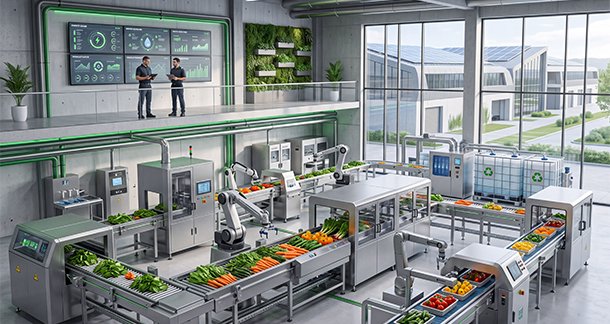
Automation and Robotics Transforming Food Production Efficiency
Automation and robotics are becoming increasingly relevant in enhancing the efficiency in current food processing facilities. The use of automation in such industries makes it possible for tasks such as sorting, weighing, filling, packaging, labeling, palletizing, and handling to be done much faster than in manually operated systems. Robots can also assist in production environments that involve repetitive movement or work, extreme conditions, or stringent hygiene levels.
Current automated systems with sensors and machine vision technology can identify products, determine their location, and carry out specific movement activities in line with production processes. It is also possible to combine automated processing equipment with centralized manufacturing systems to enable coordination during various stages of production, which assists in reducing bottlenecks during production and ensuring that there is consistent production.
One of the most significant benefits of automation is efficient use of resources. Machine technology makes it possible to measure all ingredients and materials used during production, hence minimizing any wastage. Automated inspection technology can help in detecting defective products before packaging and distribution, hence helping the manufacturer maintain quality standards.
AI and IoT Enabling Real-Time Monitoring and Quality Control
In addition, artificial intelligence and Internet of Things technologies are being used to facilitate monitoring of manufacturing process and product quality at food manufacturers’ companies. IoT sensors can provide continuous data collection from processing machinery, storages, production lines and environmental parameters. Temperature, humidity, pressure, moisture level and performance of machines can be measured continuously, giving manufacturers an increased transparency of their processes.
AI-based technology allows processing of this amount of data and detecting some patterns that can indicate certain issues. Predictive analytics, for instance, may help in spotting any anomalies that indicate a risk of equipment failures that will allow maintenance staff to take preemptive actions.
Vision system based on artificial intelligence can be also helpful in inspecting product quality by spotting any defects, potential contamination, wrong packaging or product appearance. In contrast to periodic manual inspection, this technology can provide constant monitoring of products during their movement along the production line. Overall, thanks to the use of both technologies, manufacturers can achieve increased speed of decision-making and enhanced quality control. As the amount of operational data generated by food manufacturers continues to grow, intelligent analytics becomes increasingly important.
Advanced Processing Technologies Supporting Food Safety and Sustainability
Food processors are implementing new processing technologies that enhance safety and lessen the effect of the processing on the environment. Processing technologies such as high-pressure processing, automatic thermal processing, membrane filtration, intelligent refrigeration and advanced drying could help in stabilisation of food products and efficient utilisation of resources. Advanced processing technologies allow processors to gain control over key variables, ensuring high-quality products.
Automated sensor systems and automated controls are helping to increase safety by continuously monitoring critical parameters during the manufacturing process. In case any parameter deviates from the desired level, manufacturers will be alerted for timely intervention. In addition, automation is decreasing the need for manual monitoring and intervention during the processing process.
Another benefit that advanced food processing can provide is sustainability. Smart machines will be able to determine the right amount of energy, water, and raw materials based on the manufacturing processes. Analytics can also be used to detect where the company wastes its resources needlessly. Enhanced process control can ensure fewer rejects and less food waste. Moreover, good packaging and refrigeration will help to prolong the shelf life of products. All these technological developments allow companies to reconcile productivity, food safety, and environmental concerns.
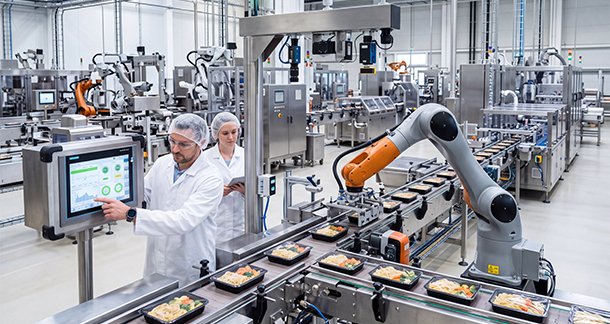
The Future of Smart Food Manufacturing: Innovation, Efficiency, and Scalability
The future of food manufacturing will involve an increasing trend toward integration, automation, and digitization. With advances in technologies like AI, robotics, IoT, machine vision, digital twin and cloud analytics, manufacturers will have more chances to optimize their manufacturing process, starting from raw material handling and finishing with the final distribution of the product. Connected factories can leverage connected systems to get real-time data about their performance, equipment, inventories and quality.
One of the major advancements will be an increased reliance on predictive and autonomous systems. Rather than solving problems after they arise, the manufacturers will be able to predict equipment failure, changes in demand, quality problems, and resource needs by leveraging AI-based analytics. As a result, this will allow for reducing downtime and improving production planning. Additionally, flexible automation will make it possible for factories to change the product types more effectively and facilitate customized production and customer demand.
By leveraging smart technologies, it will be easier for manufacturers to achieve scalability by being able to standardize the process and manage many production units from one platform. Nevertheless, for successful implementation, investments in digital infrastructure, workforce training, cyber security, and technology integration will be necessary. In conclusion, smart food processing will help the manufacturers create more effective and sustainable production systems while taking into account customer expectations.
Conclusion
The advent of smart technologies is revolutionizing the food manufacturing industry through increased productivity, efficiency, safety, quality, and sustainability. With the use of automation, robotics, AI, Internet of Things (IoT), sensors, and other processing systems, food manufacturers will be able to analyse their processes in real time and make more informed decisions based on available data. Such innovations will help cut down mistakes, minimize downtime, conserve energy and minimize wastage of food products while ensuring consistent quality in the food products being manufactured. The demand for safe, sustainable and high-quality food products will only grow and there is no question that smart manufacturing will have an even bigger role to play in the future.