We live in a world which throws away a third of the food we grow, throughout the manufacturing process, from farms, factories, kitchens and then your dinner plates. In addition to this, many food byproducts are discarded because most people assume that they can not be repurposed. In the coffee processing industry however, people have started repurposing a by-product: coffee silverskin in baked goods.
Coffee silverskin (CSS) is the thin outer layer which surrounds the coffee bean (think of it as the same coating peanuts have), and during the roasting process it detaches from the bean and is usually discarded. Published research indicates that CSS has several beneficial properties that include; high dietary fibre and phenolic compounds such as antioxidants. In addition to that, the natural coffee profile of CSS compliments cocoa-based products like brownies. So these characteristics could make CSS a value addition to cocoa products.
Therefore, partially replacing proportions of flour in brownies with CSS would help to find out the maximum consumer acceptance levels of CSS in brownies.
One Industry’s Trash is another One’s Treasure
This study sprung from a product development internship I had done at Beachville Coffee Roasters in Chennai. During my time at their roastery, I noticed a significant volume of silverskin being discarded, which prompted me to raise a question: could this material be repurposed and used in another product instead? After some research, I found multiple reports of its usage in baked goods, like cookies. However I wondered why no one had considered cocoa based confectionery as their flavour profiles compliment each other and many consumers enjoy coffee and chocolate together. The objective of this study is to find the right CSS inclusion level at which the brownie enhances desirability and purchase intention.
How Much is Too Much?
The development was carried across 3 trial concentration ranges.
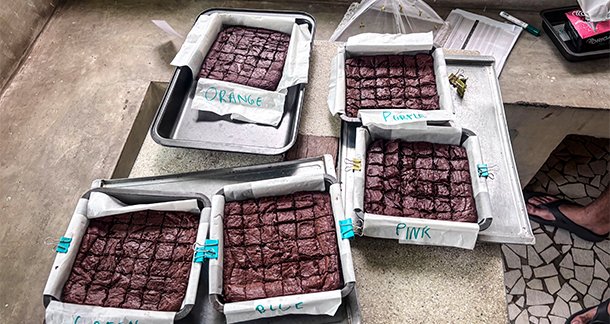
Across all the formulations the combined mass of flour and CSS remained constant. The CSS was collected from Beachville and it was finely ground in a food processor and sieved before replacing a percentage by mass of all purpose flour with CSS. The brownie recipe was adapted from Easy Peasy Foodie with all the other ingredients remaining constant throughout:150g butter, 60g cocoa powder, 2 eggs and 300g soft brown sugar
The first ran from 0-5%, with increasing increments of 1%, and at such a low range there were inconspicuous differences between each formulation which was eventually meaningless for analysis.
The second round tested from 0-25% at 5% incremental increases, here the bitterness, graininess and dryness increased substantially with every 5% increase to the point where they were becoming unpalatable. These trials helped establish the upper boundary and made the third round far more focused.
The final consumer trial tested 5 replacement formulations: 0%,2%,4%,6%, and 8% CSS .
The Blind Verdict
I received 31 valid responses from 40 random members of the public as responders, who each evaluated all 5 coded brownie samples in a blind tasting conducted outside a cafe. The brownies were evaluated for overall liking, flavour, texture, appearance, aftertaste, bitterness, graininess, moistness, and purchase likelihood. The sample order was randomised and water was provided between samples.
The mean overall liking score ranged from 3.45 to 3.79 on a five point scale and the 8% formulation achieved the highest mean score at 3.79 while the 2% formulation received the lowest at 3.45. These differences were not statistically significant implying that across 0% to 8%, consumer acceptance remained the same.

The control sample was selected as the preferred sample most often, by 10 of 31 participants in the structured trial hence the 8% formulation should be read as a promising upper working level, not a proven optimum.
The graininess increased with the CSS concentration, from a mean of 1.65 at 0% to 2.52 at 8%. Bitterness followed a similar pattern. These characteristics did not affect overall acceptance within the tested range, but they represent the limiting factors that any further development will need to address.
Does the Story Matter?
Post the blind tasting, the participants were informed about CSS; what it does, where it comes from and its potential as a functional food ingredient. This information increased the likelihood of them repurchasing the product as the story behind the ingredient made people curious. However, ‘taste’ remained the factor cited most often in purchase decisions, followed by ‘texture’ and ‘price’.
To Conclude
These brownies are proof that something routinely discarded at the roastery can become an ingredient that consumers accept. The next stage is to work within the 6-8% range more precisely by controlling for batch variation and running nutritional and safety analyses before any wider application can be considered.
Author’s Acknowledgements
This research would not have been possible without the guidance of Harsha Pore, Food Scientist and Sensory Analyst, Mumbai, whose experience, patience and willingness to work through every version of this up-cycling research project with me and made this whole project possible. Thank you to Divya Jayashankar, Beachville Coffee Roasters for introducing me to the world of coffee, the bags and bags of silverskin and of course for the many cups of coffee to count! The base recipe was adapted from Eb Gargano’s Easy Cocoa Powder Brownies on Easy Peasy Foodie.
About the Author
Miraya R. – MCTM Chidambaram Chettyar International School, Chennai