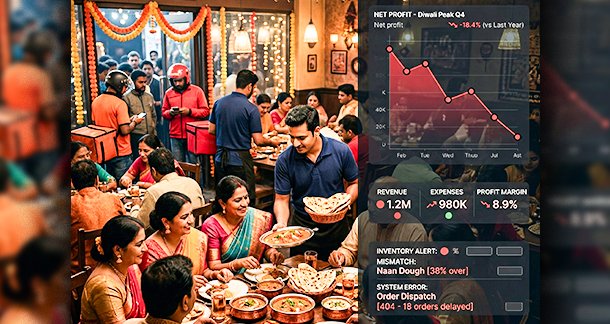
On a busy peak-season evening, during festivals, valentine’s week or major celebrations, a restaurant may appear to be thriving — tables with full orders are flowing in and delivery riders are lined up. Yet, while operations seem smooth in the moment, the financial reality often tells a different story when performance is reviewed over time. Margins remain under pressure, inventory mismatches persist, promotions fail to deliver expected returns, and customer experience varies across channels. This disconnect is increasingly common in today’s restaurant industry.
The root cause is not a lack of demand or operational effort, but the way decisions are made. Many restaurants still rely on fragmented data systems — leading to delayed insights and intuition-driven choices. In a highly competitive and complex market, this approach is no longer sustainable.
The Cost of Fragmentation
India’s food service industry is among the largest in the world — with an estimated 10 – 12 million outlets. However, much of this ecosystem remains fragmented, price-sensitive, and technologically underdeveloped. Within it, a more organized and growth-oriented segment, comprising QSR chains, franchise-led brands, cafés, bakeries, cloud kitchens, and mid-sized restaurant groups, is emerging. This segment, estimated at 5-6 lakh outlets, is increasingly adopting integrated technology platforms to manage multi-channel operations, including dine-in, delivery, QR ordering, kitchens, inventory and reporting — along with AI-driven tools to improve productivity.
Despite access to large volumes of data through POS systems, delivery platforms, and customer interactions — many restaurants struggle to use this data effectively. The issue lies not in data availability, but in the inability to integrate and interpret it meaningfully. Multiple disconnected systems create inefficiencies and hidden costs.
For instance, when menu updates are not synchronized across platforms, it results in customer confusion and lost sales. Disjointed promotional strategies can erode margins without delivering results. Pricing inconsistencies between dine-in and delivery channels further complicate customer experience. In kitchens, lack of system integration can slow operations and increase errors, while system downtime and lag during peak hours can lead to missed orders, delayed fulfillment and further impact customer satisfaction.
The Shift to Unified Restaurant Operating Systems
To address these challenges, the industry is shifting towards unified restaurant operating systems that consolidate multiple functions into a single platform. This transition is redefining how restaurants operate. Instead of managing separate tools, businesses can access a centralized system that provides a comprehensive view of operations.
Such systems ensure that changes made centrally — whether in pricing, menus or promotions —are reflected instantly across all channels, creating a consistent customer experience. At the same time, they allow flexibility at the outlet level, enabling businesses to respond to local demand while maintaining overall control. Real-time synchronization reduces discrepancies and operational friction.
More importantly, unified platforms convert data into actionable insights. Rather than relying on static reports, operators gain access to real-time intelligence that directly impacts decision-making. They can quickly identify high-wastage menu items, assess the true profitability of delivery channels after commissions, evaluate the effectiveness of promotions and detect revenue losses caused by stock-outs. This shift from passive reporting to active decision-making is central to improving performance.
Systems That Help Restaurants Grow
The technology underpinning these platforms is equally critical. Modern systems are built on micro-services architecture, allowing individual components to evolve without disrupting the entire system. Dual-cloud infrastructure enhances reliability and ensures business continuity, while edge-enabled capabilities support operations even in environments with inconsistent connectivity. These features are particularly important in restaurants, where peak-hour performance and system uptime are essential.
Compliance and data integrity are also becoming critical pillars of sustainable growth. Restaurants require systems that maintain accurate, tamper-proof records, including immutable invoices and complete transaction traceability. The ability to alter financial data without proper audit trails poses significant risks. As a result, compliance-focused and ethically designed systems are becoming a necessity.
For growing restaurant businesses, especially those expanding across locations and channels, the need for consistency and control is even more critical. Integrated platforms provide the foundation for scalable growth — enabling businesses to expand without proportionately increasing operational complexity.
So, when that same restaurant looks busy during a peak festive evening, the real question is no longer how many tables are filled or how many orders are processed, but whether every one of those transactions are working as efficiently and profitably as they should. The real picture only becomes clear when consolidated data is reviewed, often weeks later, revealing whether high demand truly translated into strong margins. With unified systems in place, the end-of-day story can finally match the energy on the floor, where strong demand translates into strong margins, seamless operations, and a consistently reliable customer experience.
The author is Founder and Chief Executive Officer of Sapaad, a global SaaS company redefining restaurant technology through its unified commerce and restaurant management platform.
By Vishnu Vardhan Madabhushi