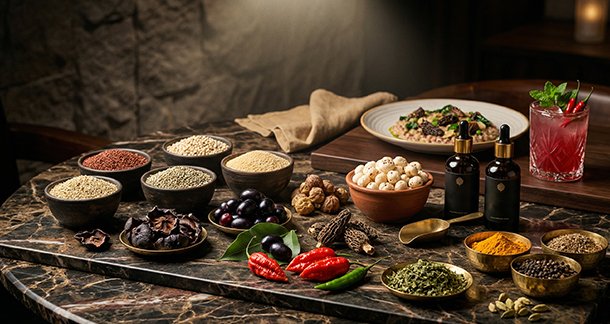
Clean ingredients, valued for their sustainability and premium quality, are redefining global gourmet luxury food. Clean Indian ingredients are the latest entrant in this market. They are becoming the favorites among global culinary maestros to create unique gourmet offerings. This rise is an ode to the Indian ingredients long known for being highly nutritious and versatile. Let us discover the ins and outs of the global rise of clean Indian ingredients as the new gourmet luxury eating.
Defining clean ingredients
When we say clean ingredients, they are defined by many qualities that keep them optimal. Firstly, there is little to no processing involved to keep the ingredients as natural as possible. Of course, it includes no additives or preservatives used to treat them.
Their labels are kept natural. Nothing is hidden. You know what is involved in creating the ingredients and where everything came from. You can be assured of the high quality of the ingredients.
The very organic nature, sustainability, and purity, as well as the nutritional goodness that uplifts health and wellness, trustworthiness, superiority in terms of flavour and quality, and high safety ethics, are the qualities that make them desirable among astute consumers who wish to spend on luxury gourmet products.

India’s culinary history
It is common knowledge that Indian culinary ingredients pushed the country into global prominence. For thousands of years, India has been the centre of trade for spices like black pepper, turmeric, ginger, cardamom, and cinnamon. Kerala was the epicentre for this spice trade.
Traders from the world over came to India for ingredients like rice, mango, sugarcane, lentils, and saffron. With the arrival of powers like the Portuguese and English, India became a major player in the production of ingredients like chillies, potatoes, tomatoes, cashew nuts, and tea.
What kept Indian ingredients in demand throughout history was their unique flavours and aromas, Ayurvedic health components, easy compatibility with other cuisines, and their capability to provide balance to the flavours.
Indian and clean ingredients
Presently, there is a rise in the use of Indian millets like finger millet or ragi, sorghum or jowar, foxtail millet or kangni, pearl millet or bajra, and small millets or kodo/barnyard. India is not just the world’s largest producer of millets but also offers sustainable and pure nutri-cereals for gourmet eating.
There is a rise in demand for hyper-local or hyper-regional local and seasonal ingredients that are sustainable and clean. Fine dining establishments spread in Europe, the USA, Canada, Australia, New Zealand, and other such prominent places are using ingredients like Himalayan morels, wild black raspberries, jamuns, amla or Indian gooseberries, makhana or fox nuts, kokum mahua flowers, local chillies like Bhoot Jolokia, Kasuri methi, jackfruit, and banana leaves to innovate in dishes.

Why clean Indian ingredients matter
The ancient Indian medicinal tradition of Ayurveda focuses on clean eating. It is high on seasonal choices, purity, and maintaining the nutrients intact. When you combine it with the vast choices available in terms of ingredients, it is but natural that Indian ingredients get picked faster.
There is a rise in the production of ingredients that are obtained fairly, grown organically, and have low carbon footprints. Additionally, Indian labels are fast-producing artisanal ingredients high in sustainability, like cold-pressed oils and organic spices, which are gaining markets globally.
A major aspect is the versatility of Indian clean ingredients. These are no longer just for Indian food. Innovative preparations with them are creating a name for themselves. A risotto made from rajgira, or amaranth, is competing next to cocktails with kokum as the star ingredient. Jamun finds a place in avant-garde desserts.
In short, Indian clean ingredients can now adapt perfectly to modern-day culinary dishes and the complexities of global luxury gourmet market.
Authored By Shivani Sharma, Chefpreneur and Founder – Gourmestan