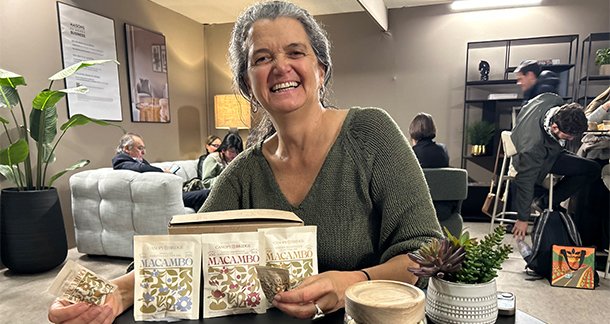
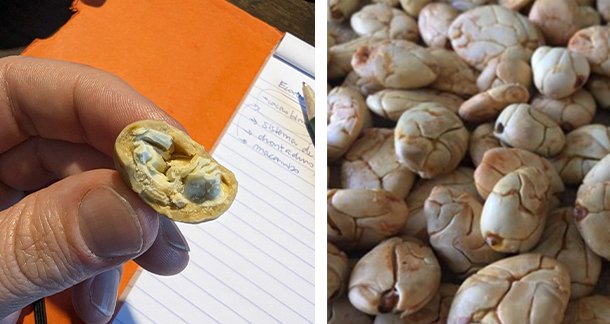
When shelled and roasted, Macambo resembles a nut. It is not only its appearance that tricks us, but also its flavor profile. Macambo tastes nutty, whether as a salty snack or combined with chocolate. However, the supposed nut is actually the seed of Theobroma bicolor, a tree from the cocoa tree family. This relative of cocoa is still relatively unknown by European consumers. But it has strong arguments that could convince the market: its taste, its versatility and its nutritional profile. The Import Promotion Desk (IPD), a project of the German Federal Ministry for Economic Cooperation and Development, has sourced the company
“Ecodecisión” from Ecuador, which is marketing Macambo under the brand name “Canopy Bridge”. At ISM 2026, the world‘s leading trade fair for confectionery and snacks, the IPD will present this special “nut” to European buyers.
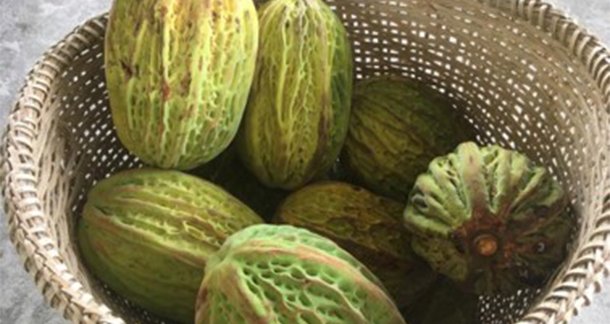
Macambo – the sister of cocoa Theobroma bicolor is a close relative of the cocoa tree. It grows in the Amazon region and is known in Ecuador as Macambo. The light-colored beans are embedded in the pulp of its fruit, just like in a cocoa fruit. This is why Macambo is also known as “white cocoa”. The beans are removed from the pulp by hand. That is where the similarities with cocoa end. The beans are simply shelled and lightly roasted before consumption. They can then be eaten raw and are suited as a sweet or savory snack.
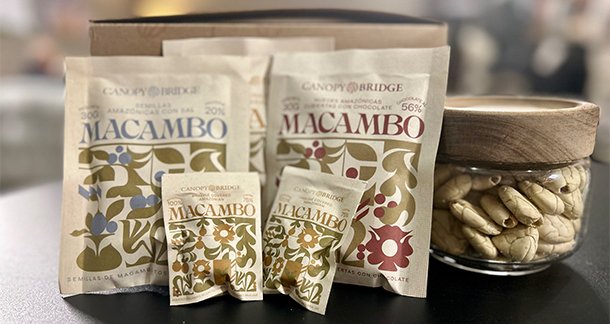
Nutty flavor
The bean, which is around three centimeters in size, is prized for its nutty flavor: it is mild but full-bodied and slightly sweet with nutty aromas of cashews, Marcona almonds and pistachios. “When you try Macambo for the first time, the flavor wins you over”, says Marta Echavarría, managing director of “Ecodecisión”. “And at the same time, you notice that the bean is very filling. That‘s because of its high protein content, which I think is Macambo‘s biggest advantage.”
Macambo is very versatile. It can be used in desserts, all kinds of baked goods, chocolate, bars, etc. In Ecuador, there are pralines made from ground Macambo beans and a Macambo spread. At the same time, it is a popular savory snack when salted. For example, finely chopped macambo nuts can be sprinkled over salads or soups like croutons. In general, Macambo goes well with savory dishes.
High protein content
Macambo is rich in vegetable proteins. According to Marta Echavarría, the content is higher than in other nuts. It also contains monounsaturated fatty acids and fibre. In addition, Macambo beans contain theobromine, which is also found in cocoa beans, coffee and tea. It has a stimulating effect, but it is much weaker than caffeine.
High-quality processing
The small farmers with whom “Ecodecisión” works harvest the cocoa pods, remove the beans, peel them by hand and deliver them to the processing plant on the same day. The beans must be absolutely fresh and must not ferment. This is a major difference from cocoa production. The fresh Macambo bean is then processed whole. It is only lightly roasted so that its flavor and texture can develop. Another method involves drying the beans at low temperatures over a longer period of time. This serves as a basis for companies that want to do the roasting themselves.
Collaboration with small farmers
The Ecuadorian company works with around 450 indigenous farmers from the Amazon region – 90 per cent of whom are women – who cultivate Macambo trees. The trees also grow wild. Until now, however, there has been no market for the beans. Through their collaboration with “Ecodecisión”, the women now have a partner who buys their beans and processes them, giving the women an opportunity to earn an income. According to Marta Echavarría, working almost exclusively with women also ensures that the income benefits the family and is invested in food and education.
“Ecodecisión‘s” corporate goal is to protect biodiversity in the Amazon region and develop financing options to achieve that goal. “Basically, our goal is nature conservation”, explains Marta Echavarría. “Macambo is a means to an end. The crucial question for us is how many farms benefit from Macambo production and how many hectares we can protect from deforestation. Our focus is on working with small farmers to build a network of agroforestry systems and thus preserve the rainforest.“
IPD at ISM 2026 – Hall 10.1, Stand F-069
Those who are interested in dark cocoa rather than white cocoa will also find cocoa and chocolate producers from Colombia and Madagascar at the IPD stand. In addition to chocolate products, they will also be presenting raw cocoa products such as cocoa beans, nibs, mass and juice at ISM. Another highlight at the IPD stand will be dried exotic fruits: a company from Colombia specialises in purple passion fruit and will be bringing it to ISM in various processed forms. A colorful basket of dried fruits will be arriving in Cologne from Madagascar, including pineapple, mango, papaya, jackfruit, physalis and lychees.