

2025: A Wake-Up Call for India’s Food Safety System
The year 2025 has emerged as a defining moment for food safety in India, exposing the hidden and increasingly complex nature of food adulteration across the country. What was once perceived as sporadic dilution or visible mixing has now transformed into organized, chemically driven adulteration practices affecting everyday foods consumed by millions. Reports from multiple states revealed contamination in staples such as milk, spices, edible oils, pulses, and animal-derived foods, underscoring that adulteration is no longer limited to isolated incidents but has become a systemic public health concern.
One of the most alarming developments reported in December 2025 was the detection of nitrofuran residues and their metabolites in eggs. Nitrofurans are banned veterinary antibiotics that are illegally used in poultry farming to control infections and enhance productivity. Their misuse, particularly without observing proper withdrawal periods, leads to residues such as AOZ, AMOZ, AHD and SEM entering the food chain through eggs. These compounds are known for their carcinogenic and genotoxic potential and pose long-term health risks, especially to children and other vulnerable populations. Regulatory alerts, intensified surveillance, and product recalls following these findings clearly demonstrated that even foods traditionally considered safe and nutritious are susceptible to invisible chemical adulteration.
These repeated outbreaks have fundamentally changed how food adulteration is perceived in India. It is no longer merely a quality or economic issue, it has evolved into a public health emergency, demanding rapid, accessible, and decentralized detection mechanisms alongside conventional laboratory testing.
Food Adulteration in India: The 2025 Scenario
India’s vast and diverse food supply chain is under increasing pressure due to rapid urbanization, rising demand for processed and ready-to-eat foods, and the continued dominance of informal food markets with limited oversight. Economic incentives often encourage shortcuts, making adulteration a persistent challenge despite strong regulatory frameworks under the Food Safety and Standards Act (FSS Act), 2006. What has changed in recent years is the nature of adulteration itself. There has been a clear shift from easily visible adulterants to sophisticated chemical residues, synthetic substitutes, and illegal additives that are far more difficult to detect without scientific tools.
Commonly Reported Adulterants in 2025
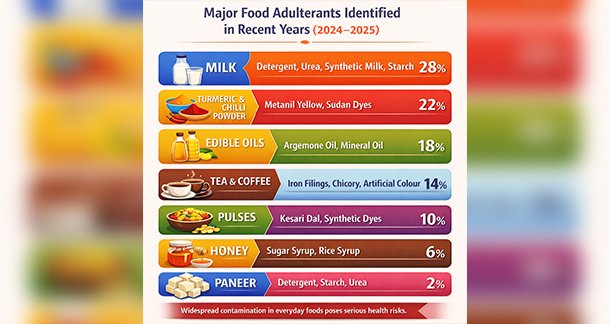
Recent surveillance and enforcement activities during 2024–2025 have highlighted repeated adulteration across commonly consumed foods. Milk has been found adulterated with detergent, urea, starch, and even synthetic milk. Spices such as turmeric and chilli powder have shown contamination with industrial dyes like metanil yellow and Sudan dyes. Edible oils have been adulterated with argemone oil and mineral oil, while pulses have been mixed with kesari dal and synthetic colourants. Honey adulteration using sugar and rice syrups remains widespread, and paneer contamination with detergent and starch continues to be reported. In animal-derived foods, particularly eggs and poultry products, antibiotic residues such as nitrofurans have emerged as a major concern. These adulterants not only reduce nutritional value but are also linked to acute poisoning, organ toxicity, hormonal disruption, antimicrobial resistance, and chronic health conditions.
How Is Food Adulteration Detected?
Food adulteration analysis in India relies on a two-tiered approach. Accredited food testing laboratories play a critical role by employing advanced analytical techniques such as GC-MS, LC-MS/MS, FTIR, UV–Visible spectroscopy, residue analysis, and microbiological testing. These methods offer high accuracy and legal validity, making them essential for regulatory enforcement and confirmation. However, they require sophisticated instrumentation, trained analysts, significant investment, and time.
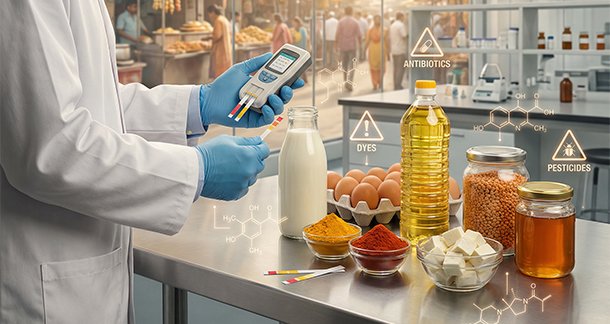
To address the need for immediate decision-making at the field level, rapid screening tools have become increasingly important. Adulteration detection kits serve as first-level screening methods that enable quick identification of common adulterants, helping prevent unsafe food from reaching consumers before laboratory confirmation is undertaken.
Adulteration Detection Kits: Rapid Answers in Critical Moments
Adulteration detection kits are designed to provide simple, rapid, and cost-effective screening within minutes. Their importance lies in their ability to support on-the-spot decision making without the need for complex instruments or technical expertise. These kits are particularly valuable for street food vendors, food inspectors, small vendors, schools, self-help groups, and food safety awareness programs. By enabling early detection at the source, they reduce the circulation of unsafe food, complement laboratory testing, and significantly ease the burden on regulatory laboratories.
References
- Food Safety and Standards Authority of India (FSSAI), Food Safety and Standards Act, 2006 and associated regulations — regulatory framework for food adulteration and safety standards in India.
- FSSAI Annual Report 2024–2025, FSSAI — highlights surveillance data, food safety trends, and national outbreak investigations.
- S. Gupta, et al., “Emerging Chemical Adulterants in Dairy and Spices: Trends in 2024–2025,” Journal of Food Safety and Public Health, 2025 — analysis of adulterants in consumables.
- A. Singh & N. Sharma, “Nitrofuran Residues in Poultry Products: Public Health Implications,” Food Chemistry and Toxicology, 2025 — overview of nitrofuran antibiotic use and detection.
About the Authors:
Divya Panneerselvam*, Surya Priyadharsini *, Mansi Thaker* & A.G. Saranya Gayathiri*
Mail: divya.bt1994@gmail.com & Address: Parikshan FSS Pvt Ltd Chennai, Tamilnadu

