

Counterfeiting has expanded from isolated infringement to a structural risk affecting public health, industrial reliability, and trade credibility. As supply chains grow more complex and digital commerce expands, unauthenticated products are penetrating regulated and consumer-facing sectors with greater speed and scale. Pharmaceuticals, FMCG, automotive components, agrochemicals, and alcohol remain among the most vulnerable categories. Within the food and beverage ecosystem, this threat carries heightened sensitivity. Adulterated edible oils, refilled beverage bottles, relabelled packaged foods, and substandard agro-inputs directly endanger consumers while eroding brand trust and formal supply-chain credibility.
The ASPA–CRISIL 2022 Report highlighted counterfeit presence ranging from 20–30 percent across key sectors. The findings underscored that the challenge is neither sporadic nor confined to informal markets. More recently, the ASPA–Accenture 2025 Report has shown that India’s Authentication and Traceability (A&T) industry, valued at ₹9,705 crore in FY 2023–24, is projected to cross ₹16,500 crore by FY 2028–29. This growth signals a structural shift: authentication is no longer a discretionary safeguard but emerging as core packaging and supply-chain infrastructure. For food manufacturers operating in high-volume, low-margin environments, this transition is particularly significant.

Packaging Becomes the First Line of Defense
Packaging is undergoing a functional transition. Traditionally protective and brand-oriented, it is now becoming the primary control point for product integrity. Serialization, secure QR codes, NFC-enabled tags, encrypted identifiers, and digital watermarks are transforming each pack into a uniquely identifiable unit.
In food processing environments where products pass through distributors, wholesalers, retailers, and HoReCa channels, packaging often represents the last secure interface before consumer access. Strengthening this interface reduces opportunities for substitution, tampering, or expiry manipulation.
Unit-level serialization assigns every product a distinct digital identity. When linked to verification platforms, this enables real-time authentication. Unlike batch-level tracking, serialized packaging narrows the scope for diversion, duplication, and grey-market substitution while enabling more precise recalls that isolate affected units rather than entire production lots.
From Authentication to End-to-End Supply Chain Visibility
Authentication confirms whether a product is genuine; traceability establishes where it has travelled and whether it followed approved pathways. End-to-end traceability frameworks enable faster recall management and identification of supply-chain breaches.
Within food supply chains, traceability supports monitoring of storage conditions, distribution routes, and stock rotation practices, particularly for perishables. In agriculture, traceable inputs protect farmer incomes and national food security. Across sectors, traceability data improves inventory planning and supplier accountability. As systems mature, alignment with globally recognized standards becomes critical to ensure interoperability and audit readiness.
Internationally, standards like ISO 22383 play a pivotal role in guiding the deployment of authentication solutions. They enable uniformity, help companies undergo structured audits, and align Indian practices with global benchmarks. Adopting such standards also prepares the sector for future export market requirements, where traceability and product integrity are non-negotiable.
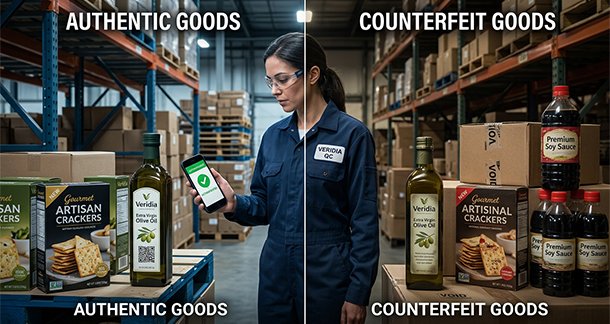
Phygital Security: Integrating Physical Safeguards with Blockchain and AI
Digital systems are increasingly reinforced by complementary technologies.
Their effectiveness, however, lies in integration with physical safeguards such as tamper-evident seals, holographic elements, microtext printing, and secure inks. A layered security architecture combining overt, covert, and digital protections significantly raises the operational complexity and cost of counterfeiting. In food and beverage packaging, tamper-evident closures, induction seals, tear tapes, and secure labeling technologies act as immediate visual deterrents, while digital verification ensures deeper supply-chain visibility.
Closing the Loop: Consumer-Led Authentication in FMCG
The ASPA–CRISIL report highlights that counterfeiting in the FMCG segment remains highly prevalent, with perceived presence estimated at 25–30 percent across categories. The level of harmfulness is considered particularly high in food-related products, where quality compromise can translate directly into consumer health risks.
The consumer survey findings reveal a concerning behavioural dimension: nearly 42 percent of respondents admitted to having knowingly purchased counterfeit FMCG products, while around 28 percent reported encountering counterfeit FMCG goods at least once. These figures reflect not only scale but also consumer decision complexity in price-sensitive environments. In such contexts, verification mechanisms must remain frictionless, accessible, and seamlessly embedded into packaging design.
Industry Alignment and Standardization Imperatives

Collaboration remains essential to strengthening authentication and traceability ecosystems, as the scale and sophistication of counterfeiting networks make it difficult for any single stakeholder to address the challenge independently. Industry platforms such as the Traceability & Authentication Forum (TAF) 2025 have facilitated structured dialogue between brands, regulators, packaging specialists, and technology providers to align on implementation challenges and emerging risks.
Building on these engagements, ASPA is convening TAF Connect 2026, a focused industry forum that will bring together senior representatives from leading brands, government authorities, enforcement agencies, and solution providers to examine sector-specific vulnerabilities and scalable deployment models. On the same platform, ASPA, in collaboration with CRISIL, will unveil the 2026 edition of its national counterfeiting assessment report. The updated study is expected to present refreshed sector-wise vulnerability data, evolving consumer behaviour insights, and analysis of enforcement gaps, contributing to a more evidence-based and coordinated response framework.
By Mr. Puneet Maithani, Director – Industry Affairs, ASPA

