
Interview with Volker Ditscher, Director Global Sales Track & Trace, Wipotec
Director Global Sales — Track & Trace | Wipotec GmbH, Kaiserslautern, Germany
With almost 19 years at Wipotec — first as a project manager leading hundreds of serialisation implementations, and now as Director Global Sales for Track & Trace — Volker Ditscher is an experienced voice in global traceability. He’s the Co-chair of the GS1 Global Healthcare Solution Provider community, a GS1 Global Healthcare Leadership Team member, part of many GS1 Global Working Groups and a founding member of the Open-SCS Working Group. He contributed to the development of the recently launched “GS1 2D Barcode Playbook for Creation and Printing”. In this exclusive interview with Food Marketing & Technology Magazine, he speaks candidly about what GS1 Sunrise 2027 means for Indian food and pharma manufacturers, the power of Wipotec’s Traceable Quality System, and the joint early-mover strategy with Safe Automations Group across India and the Gulf.
Food Magazine & Technology: The GS1 Sunrise 2027 initiative is approaching quickly. How urgent is the move from 1D to 2D barcodes for manufacturers?
Volker Ditscher: The industry has moved beyond simply observing the trend. While Sunrise 2027 is not a regulatory deadline, it represents a major industry milestone. By then, most retail point-of-sale systems are expected to support 2D codes, and leading retailers and consumer goods companies have already aligned behind the transition.
The migration affects printing technologies, verification systems, packaging software, ERP integration, and master data management. These changes take time. Companies that start now can test, learn, and scale gradually, while those that wait may face costly implementation under commercial pressure.
For Indian manufacturers supplying modern retail, e-commerce, or export markets, preparation should already be underway. Beyond compliance, 2D codes create opportunities for better transparency, traceability, consumer engagement, and brand trust.
Food Magazine & Technology: Why are 2D barcodes considered such a major advancement compared with traditional linear barcodes?
Volker Ditscher: Traditional 1D barcodes, like EAN or UPC were designed primarily to identify products at checkout through a GTIN. They provide no information about a specific unit, batch, expiry date, or origin.
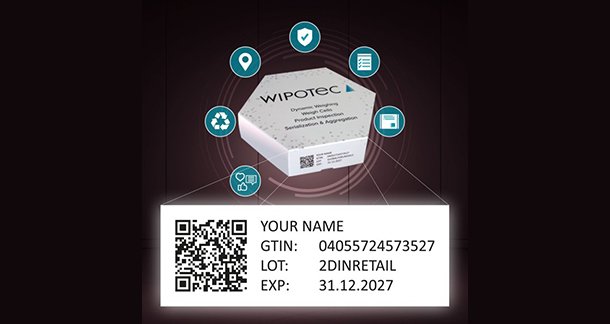
A 2D barcode, whether a standard QR code using GS1 Digital Link or a GS1 DataMatrix, can contain the GTIN, batch number, best before or expiry date, and even a unique serial number in a compact format. The same code can be read by retail scanners, warehouse systems, smartphones, and regulatory platforms.
For manufacturers, this enables far more precise recalls. Instead of recalling an entire production run, companies can identify affected batches or even individual units. For consumers, the code becomes a gateway to product information, provenance, certifications, ingredients, and brand content.
The shift from 1D to 2D is not just a technology upgrade. It creates a digital identity for every product unit and strengthens the connection between brands, retailers, and consumers.
Food Magazine & Technology: What makes Wipotec’s Traceable Quality System (TQS) particularly suitable for food and FMCG environments?
Volker Ditscher: TQS is built on experience gained from more than 3,000 global Track & Trace implementations across pharmaceutical, food, and consumer goods industries.
Three areas stand out. First, TQS is open and vendor-neutral. Manufacturers can connect existing ERP, site-level software, and IT systems through open interfaces without being locked into a single vendor ecosystem.
Second, TQS provides a unified operating environment. Our Configure Fast technology automatically synchronizes print and vision inspection settings, reducing setup times and simplifying changeovers. Printing, verification, weighing, tamper evidence, and aggregation can all be managed through a single interface.
Third, TQS goes beyond code printing and verification. It combines traceability data with weight information and quality records, creating a complete digital history for each individual unit. This concept, which we call Traceability+, allows manufacturers to maintain detailed quality records throughout the product lifecycle.
The system is designed to operate reliably at the high production speeds common in food manufacturing, while maintaining full traceability and quality control.
Food Magazine & Technology: Pharmaceutical manufacturers face multiple regulatory requirements worldwide. How does Wipotec help companies manage this complexity?
Volker Ditscher: Global pharmaceutical exporters often need to comply simultaneously with Indian DGFT requirements – demanding GS1 Data Matrix at the primary pack level, GS1-128 at secondary and tertiary, with parent-child data provided to the DAVA portal, or domestic Schedule H2 QR code requirements which are applied to the designated top 300 pharmaceutical brands since 1 August 2023. In June 2026, the scope of Schedule H2 was even expanded to include all vaccines, antimicrobials, anticancer drugs, and specified narcotic and psychotropic medicines. European FMD requirements, US DSCSA regulations, and various Gulf-region traceability frameworks.
Managing separate systems for different markets is expensive and difficult to maintain. TQS was specifically designed as a unified platform that supports multiple regulatory schemes from a single solution.
The system handles different data structures, code formats, reporting requirements, and verification processes while remaining flexible enough to adapt as regulations evolve. Country-specific label requirements and national verification connections can all be managed through the same infrastructure.
An important advantage is that software updates driven by regulatory or functionality changes can be supported throughout the system lifecycle without recurring software licensing costs, helping manufacturers remain compliant while controlling long-term expenses.
Our long-standing involvement with GS1 standards development also helps ensure that customers are prepared for future regulatory and industry requirements.
Food Magazine & Technology: Counterfeiting remains a major challenge. How can serialisation and traceability help?
Volker Ditscher: Counterfeiting is ultimately a safety issue, particularly in pharmaceuticals but increasingly in food or many other products as well.
Serialisation gives every individual product unit a unique identity. Instead of tracking only batches, manufacturers can identify a specific package, where it was produced, how it moved through the supply chain, and whether it is genuine.
While counterfeiters may visually copy a barcode, they cannot replicate secure serial number validation against a central database.
TQS also creates aggregation relationships between products, cases, and pallets while recording supply chain events through EPCIS. This makes it possible to trace products through every stage of distribution and identify where suspicious products entered the supply chain.
As 2D codes become more common in FMCG products, consumers themselves will increasingly participate in product authentication through simple smartphone scans.
Food Magazine & Technology: Many manufacturers operate older packaging lines. How difficult is implementation?
Volker Ditscher: Most manufacturers do not need to replace entire production lines. We offer modular TQS-OEM kits that integrate printers, cameras, and labelling technologies into existing packaging equipment from a wide range of suppliers.
One of the first areas we evaluate is print quality. Technologies that work well for traditional 1D barcodes may not consistently produce high-quality, machine-readable 2D codes at production speeds. In some cases, upgrades to thermal transfer, thermal inkjet, or laser technologies may be recommended.
Implementation generally follows four stages: readiness assessment, system design, installation and commissioning, and final validation. The goal is to achieve compliance and operational readiness while minimizing disruption to ongoing production.
Food Magazine & Technology: How do 2D barcodes support both product identification and consumer engagement?
Volker Ditscher: This is one of the most exciting aspects of the technology. A single 2D code can serve multiple audiences simultaneously.
At checkout, retailers use the code for product identification. Within the supply chain, it provides traceability and serialisation data. For consumers, the same code can open a brand-controlled digital experience.
That experience might include nutritional information, allergen details, sustainability data, sourcing information, recipes, or loyalty programs. One code can therefore support retail operations, supply chain efficiency, and customer engagement at the same time.
Given India’s large smartphone user base and widespread familiarity with QR code technology, the potential is particularly significant. The key requirement is ensuring that every code is printed accurately, verified consistently, and linked to reliable product data.
Food Magazine & Technology: Looking beyond 2027, how do you see traceability evolving by 2030?
Volker Ditscher: Manufacturers investing in GS1-based 2D infrastructure today are building a foundation for future developments.
One major trend is Digital Product Passports, which are being introduced for various product categories and rely on many of the same technologies used in 2D barcode systems today. Another is the convergence of 2D and RFID technologies. These should be viewed as complementary tools within a broader traceability architecture rather than competing solutions.
A third trend is increasing interoperability through standards such as EPCIS, enabling trusted data sharing across connected supply chain ecosystems.
My advice to leaders in food and pharmaceuticals is straightforward: view 2D barcode adoption as a strategic opportunity rather than a compliance exercise. It creates the digital identity infrastructure that will support future requirements, improve transparency, strengthen supply chain visibility, and help companies compete in increasingly connected global markets.