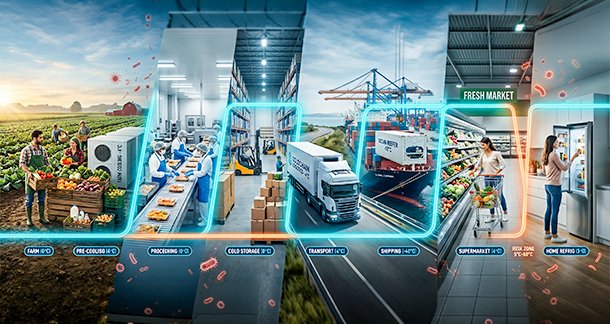
In today’s increasingly globalized food system, ensuring the safety and quality of perishable products has become more complex than ever before. Food items now travel across cities, countries, and even continents before reaching the consumer’s plate. In this intricate network of production, processing, storage, and distribution, one factor remains consistently critical — temperature control. This is where cold chain integrity assumes central importance.
Cold chain integrity refers to the continuous maintenance of prescribed temperature conditions throughout the entire supply chain of perishable food products. It is not limited to refrigeration at a single stage; rather, it encompasses an unbroken system of temperature management from primary production to final consumption. Any interruption, however brief, can compromise food safety, reduce shelf life, and lead to significant economic and public health consequences.
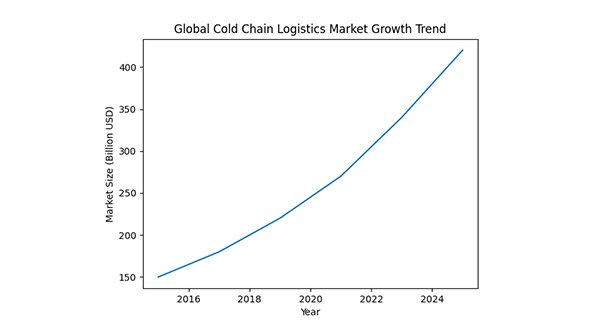
Global Chain Logistic Market Growth Trend (2015-2025)
The upward trend highlights increasing investment in temperature-controlled logistics.
What Do We Actually Mean by “Cold Chain”?
The cold chain is a temperature-controlled supply chain system designed to maintain perishable food products within specific temperature limits from production to consumption.
Cold chain is not confined to a single refrigerated unit; it represents a coordinated system that begins at the point of harvest or slaughter and continues through processing, cold storage, transportation, distribution centres, retail environments, and ultimately into the consumer’s home. Each stage must function in alignment to maintain uninterrupted temperature control. Even a minor lapse during transfer between stages can compromise the entire system.
Why a Few Degrees Matter So Much
Most foodborne pathogens grow in what is called the temperature danger zone:5°C to 60°C
Most pathogenic microorganisms multiply rapidly within what is commonly referred to as the temperature danger zone, typically between 5°C and 60°C. When food is exposed to this range, bacterial growth accelerates, toxin production may begin, and shelf life decreases significantly. Even short-term exposure can initiate microbial activity that cannot be reversed simply by re-chilling the product.
Here’s something important:
- Refrigeration slows bacterial growth. It does not kill bacteria.
- Freezing makes many microorganisms dormant. It does not sterilize food.
And once bacteria multiply or toxins are formed, simply lowering the temperature again does not reverse the damage.
Cold chain failure is often irreversible.
The Concept of Cold Chain “Integrity”
Temperature control alone is not enough. Cold chain integrity means:
- Continuous temperature maintenance
- No breaks during transitions
- No unmonitored exposure
- Proper documentation
- Immediate corrective actions
Integrity means the chain remains unbroken — from farm to fork. Even one weak link compromises the whole system.
Stage 1: Primary Production – Where Risk Begins
Freshly harvested produce and freshly slaughtered meat are biologically active materials. Milk leaves the animal at approximately 37°C.If not chilled to below 4°C quickly, microbial growth begins almost immediately.
For fruits and vegetables:
- Field heat must be removed
- Pre-cooling methods (hydrocooling, forced air cooling, vacuum cooling) are essential
- Delays reduce shelf life dramatically
For meat and poultry:
- Rapid chilling prevents microbial multiplication
- Proper carcass cooling reduces contamination risk
Initial temperature control determines downstream safety performance. A mistake here cannot be corrected later.
Stage 2: Processing Facilities – Controlled Yet Vulnerable
Within processing facilities, temperature control appears well regulated; however, operational realities introduce vulnerabilities. Overloading of cold rooms, improper stacking that blocks airflow, frequent door opening, and inadequate maintenance can create localized temperature variations. Without regular temperature mapping and validation studies, such inconsistencies may go unnoticed, leading to gradual quality deterioration and potential safety risks. Cold rooms are designed with airflow patterns. Blocking those patterns creates hot spots. Temperature mapping studies are necessary to identify:
- Warm zones
- Uneven cooling
- Inefficient insulation
Without validation, assumed control may be false control.
Stage 3: Cold Storage – The Silent Holding Point
Cold storage facilities are designed for long-term preservation, yet they are not immune to risk. Power failures, generator malfunction, damaged door seals, refrigerant leakage, or improperly calibrated sensors can result in temperature fluctuations. Even a small but sustained deviation may accelerate chemical spoilage and microbial growth, reducing both safety margins and commercial shelf Life.
Stage 4: Transportation – The Most Fragile Link
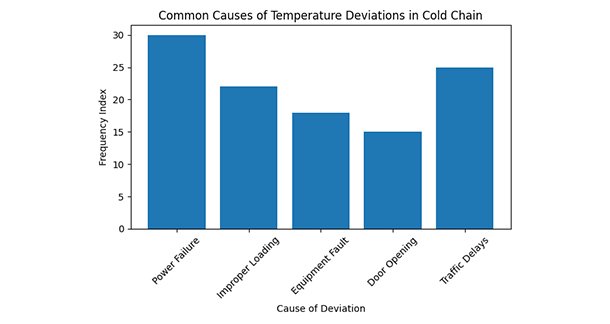
Transportation is often the weakest point. Refrigerated trucks are not cooling machines; they are temperature maintenance systems. Common failures include:
- Loading warm product into a cold truck
- No pre-cooling of vehicle
- Traffic delays
- Frequent door opening
- Fuel shortages
- Poor insulation
- Lack of monitoring
Temperature abuse during transport may go unnoticed until product reaches retail. And by then, corrective action is limited. Long-distance exports face additional risks:
- Port delays
- Customs clearance time
- Container stacking
- Power interruption at terminals
One compromised shipment can cause massive economic loss.
Stage 5: Retail – Where Control Meets Consumer Behaviour
Retail environments are complex.
Open display cabinets are vulnerable to:
- Ambient temperature
- Customer interaction
- Overstocking
- Inadequate airflow
Frequent door opening in freezers allows warm air entry. Supermarkets sometimes prioritize display aesthetics over airflow efficiency. Temperature monitoring at retail must be:
- Continuous
- Documented
- Verified
Otherwise, shelf-life labels become unreliable.
Stage 6: The Consumer – The Final Link
Cold chain doesn’t end at purchase. Consumer handling affects safety:
- Long travel time in hot weather
- No insulated bags
- Delayed refrigeration at home
- Overcrowded refrigerators
- Improper temperature settings
Domestic refrigerators should ideally be maintained at:1–5°C, Freezers at: -18°C
Yet many home refrigerators operate above safe levels. Consumer education is a missing component of cold chain integrity.
Author
Ashutosh Jaiswal
Food Safety Professional
Email: ashuthewall@gmail.com
Website: https://www. foodsafetywithashutosh.com
Author
Ayushi Shukla
Food Safety Professional
Email: ayushishukla2223@gmail.com