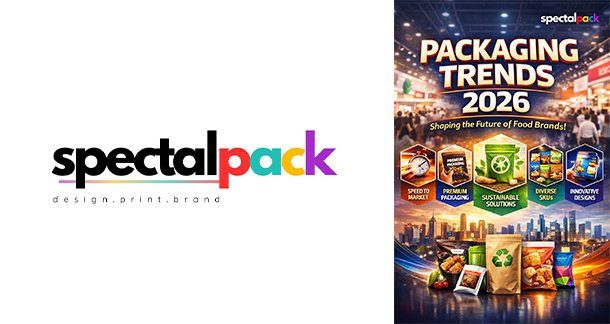
Every year, AAHAR – The International Food & Hospitality Fair serves as more than just a marketplace — it is a strategic barometer for the Indian food ecosystem. In 2026, AAHAR stands at the intersection of innovation, expansion, and brand differentiation, demonstrating that packaging is no longer a background function, but a core driver of growth for food brands.
In an era where consumers are increasingly driven by convenience, sustainability, and aesthetic appeal, packaging has become a competitive advantage.
Market Statistics: Packaging’s Rapid Growth in 2026
The numbers tell a compelling story:
- India’s flexible packaging market is projected to grow at a CAGR of ~8–10% through 2027, outpacing many traditional formats.
- Overall food packaging value in India is expected to exceed USD 40 billion by 2026, fuelled by rapid urbanization, modern retail expansion, and e-commerce demand.
- Product launches with premium packaging witnessed a 35% higher first-quarter sales lift compared to standard packaging formats across major retail channels.
These figures reflect a fundamental mindset shift — packaging has graduated from cost center to strategic growth lever.
These statistics underscore a powerful trend: packaging is no longer an afterthought — it is an investment that delivers tangible business impact. Digital print, shorter run lengths, and smarter production planning are helping brands keep pace with trends instead of lagging behind them.
- Speed to Market Is the New Competitive Advantage
One of the clearest signals from AAHAR halls this year is the demand for agility. Emerging food brands are less willing to accept long lead times for packaging production. Seasonal SKUs, festive editions, export variants and D2C pack formats demand shorter run lengths and faster approvals.
Digital printing, standardised substrates, and quicker prototyping processes are helping companies reduce concept-to-shelf cycles from months to weeks. For dynamic brands, this speed is a key differentiator — enabling them to respond rapidly to consumer trends without overstocking.
- Premiumisation at Every Price Point
A walk through AAHAR reveals that premiumisation is no longer confined to high-end products. Consumers today associate packaging quality with product authenticity and trust. Visual elements like metallic accents, soft-touch finishes, and high-definition graphics no longer signal luxury alone — they influence first purchases in mainstream segments as well.
In categories such as ready-to-eat, snacks, spices, and functional foods, packaging quality now directly correlates with shelf influence and repeat sales. Consistency in print quality, colour accuracy, and seal integrity is becoming non-negotiable.
- Sustainability Moves from Buzzword to Benchmark
Sustainability isn’t a tagline — it is now a requirement that unlocks access to modern channels.
Retailers and exporters at AAHAR not only asked about recyclability — they evaluated mono-material structures, downgauging opportunities, and end-of-life alignment with recycling systems.
The challenge — and opportunity — is clear: reduce material footprint while preserving barrier performance and visual appeal.
Brands that proactively adopt recyclable or downgauged solutions are gaining preference in organized retail and export markets.
- Smaller Batches, Wider SKU Portfolios
Another dominant theme visible at AAHAR is SKU proliferation. Today’s brands are launching multiple flavours, formats and weights to cater to diverse channels — from supermarkets to express delivery platforms.
Flexible packaging must be capable of:
- Low minimum order quantities (MOQs)
- Frequent artwork revisions
- Multi-size runs
- Rapid repetition cycles
This new reality is pushing converters and suppliers to adopt smarter workflows that keep costs predictable even at smaller scales.
- Packaging as a Strategic Growth Lever
Perhaps the most defining evolution is mindset. Organizations no longer treat packaging as operational cost — they view it as a growth catalyst.
At AAHAR 2026, conversations shifted from compliance and cost management to brand identity, consumer engagement, and channel strategy.
Packaging decisions now influence:
- First impression and brand recall
- Online unboxing experience
- Logistics and shelf life performance
- Channel-specific presentation (modern retail vs. wholesaler vs. D2C)
AAHAR — Where Strategy Meets Scale
AAHAR doesn’t simply showcase products. It serves as a convergence point for insights, partnerships, and future-ready solutions.
For food brands navigating 2026 and beyond, packaging is no longer a supporting act — it is the lead performer. Those who embrace speed, premiumisation, circularity, and agility will redefine growth trajectories.
And for partners like Spectalpack, the mission remains clear: empower brands with packaging that works as hard as their vision.