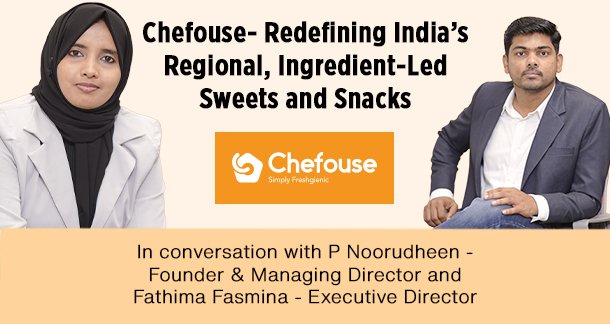
In conversation with K P Noorudheen – Founder & Managing Director and Fathima Fasmina – Executive Director, they delve into the company’s trajectory, trends in the sector, their specefic role in it, and their future plans.
Question- How has the trajectory of your company been so far in this sector and what are the lessons that you have cultivated?
Chefouse is being built with a long-term vision of creating a national brand for India’s regional snacks, and our journey so far has focused on developing multiple village-based food factories to tap into authenticity—of ingredients, food culture, and traditional know-how. We are currently in the early growth stage, with our products available in retail stores across Kerala and also sold online to customers all over India.
This phase has offered valuable learnings. One key lesson is that the market is always open to new products when they are authentic and well executed. Another important learning is the need to build systems aligned to your own business model, rather than simply adopting generic industry practices. Starting these systems early has helped us continuously refine our processes and move closer to building a scalable yet authentic food brand.
Question- Working in this niche sector, how do you think the healthy sweets category is booming? How much will it grow in the next five years?
Today, almost everyone understands the importance of eating healthy, but the definition of what is healthy varies from person to person and continues to evolve. The popular definition of healthy eating—based purely on cutting out foods—is neither practical nor sustainable in the long run.
We see the future moving towards diversity of crops, where foods are made from varied grains and ingredients so the body receives balanced nutrition, with no nutrient excess and no nutrient deficiency. As this understanding deepens, the idea of completely avoiding sweets as a healthy habit is gradually declining. Instead, sweets are evolving into more thoughtful, ingredient-driven formats.
Looking ahead, this evolution will shape the next phase of growth in the category. We expect the healthy sweets segment to grow steadily at 15–20% CAGR over the next five years, driven by innovation in ingredients and formulations, rather than elimination-based positioning.
Question- What are some of the biggest challenges you’ve faced in scaling your bakery products (e.g., cookies) without compromising taste or quality?
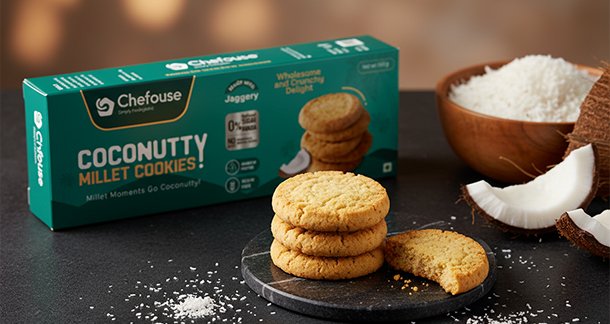
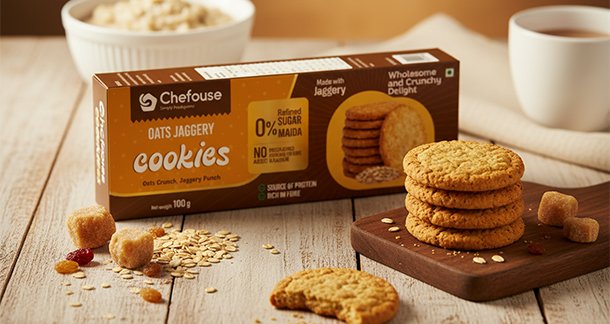
Since Chefouse does not follow conventional bakery product formats, we face unique challenges while scaling. Our use of ingredients such as jaggery and millets, instead of refined flour and refined sugar, means working with supply chains that are still evolving and less standardised.
Variations in these ingredients affect baking behaviour, taste, and texture, making consistency at scale more demanding. Overcoming this requires tighter sourcing control, clearly defined specifications, and continuous quality validation. While challenging, this approach is essential to preserve the integrity of our products and our commitment to non-conventional formulations.
Question- How do you ensure quality and consistency across batches, especially with high-demand items like cookies?
At Chefouse, we strongly believe that quality ingredients lead to quality products. Our quality assurance begins with raw material sourcing based on strict specifications defined by our R&D, ensuring consistency and reliable performance from the very first step.
This foundation is reinforced through expert supervision, a highly committed team, and a world-class production facility designed around hygiene and process discipline. By following a systematic, end-to-end approach across sourcing, production, and packing, we are able to maintain consistent quality and taste across batches, even for high-demand products like cookies.
Question- What are the trends that you foresee in this sector and what are your plans for the future?
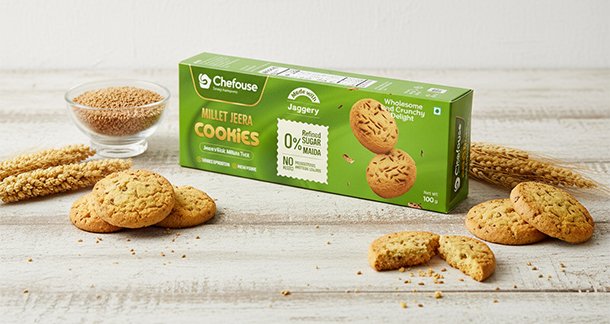
A key shift we see in the sector is a move away from elimination-driven positioning—such as completely removing sugar or maida—towards an inclusion-led approach. Large and credible players are increasingly focusing on adding better ingredients, improving ingredient diversity, and creating more balanced formulations rather than promoting extreme exclusions.
This reflects a growing consumer understanding that long-term healthy eating comes from variety and inclusion, not restriction. Alongside this, hygiene is becoming non-negotiable. Consumers will no longer compromise on how food is produced, and a sector historically challenged by hygiene standards is now undergoing a necessary transformation.
At Chefouse, our plans are aligned with these trends. We are building truly diverse snack options while setting new benchmarks in hygienic, transparent manufacturing. Our focus to lead this shift by demonstrating that inclusion of good ingredients, backed by world-class hygiene, is the future of the bakery and snacks sector.