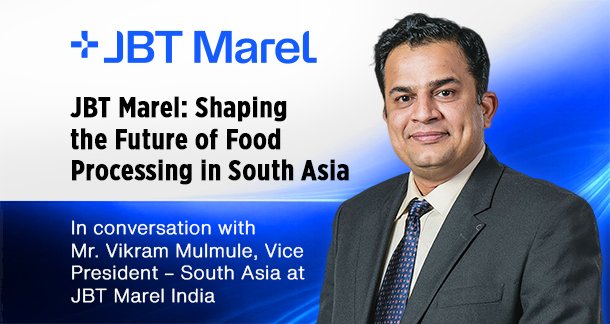
In conversation with Mr. Vikram Mulmule, Vice President – South Asia at JBT Marel India, he delves into how the landmark JBT–Marel merger is redefining end-to-end food processing solutions across South Asia, and why JBT Marel is uniquely positioned to lead the region’s next wave of food technology innovation.
Question- The merger that created JBT Marel brought together two iconic names in food processing technology. How has the combined entity redefined what “end-to-end solutions” means for food and beverage processors today?
The JBT–Marel merger has redefined “end-to-end solutions” by integrating complementary strengths—JBT’s expertise in value-add processing, robotics, and automation with Marel’s leadership in precision grading, primary & secondary processing, portioning, and software. Together, we deliver seamless, data-driven solutions across the entire food value chain—from primary processing to final packaging. This unified approach enables us a greater traceability, efficiency, and customization, helping processors optimize yields, reduce waste, and adapt quickly to market demands through connected, intelligent systems rather than standalone equipment.
Question- JBT Marel serves an extraordinarily diverse portfolio, from poultry and salmon processing to infant formula, pet food, and plant-based beverages. How do you manage innovation across such varied categories without losing depth in any one of them?
We focus on platforms, not just products, and then localize for India. Core technologies—automation, hygiene, digital monitoring, sustainability—serve poultry, seafood, dairy, plant-based and traditional Indian foods alike. We pair global R&D with Indian application centers and local technologists who understand regional raw materials, recipes, and regulations. Cross-functional teams transfer learnings—for example, from poultry yield optimization to value-added snacks or dairy-based beverages—while a disciplined portfolio process ensures we don’t dilute depth in any one category.
Question- Software and data are increasingly central to your offer alongside hardware. How are food processors today actually using your platforms to drive profitability? can you share a concrete example of what “data-driven decisions” looks like on a production floor?
Food processors are using our software to turn real-time line data into immediate action, not just reports. Across any production line, the platform continuously tracks yield, quality, throughput, uptime, labor, and resource use. When performance shifts—even slightly—it pinpoints the exact step, product batch, shift, or condition driving the change and recommends corrective action.
For example, if product giveaway rises on a poultry line, the system flags the specific station, product, and operator, then suggests adjustments to cutter settings or processes. Supervisors see this instantly on dashboards or mobile devices and can act within minutes. Decisions move from reactive to real-time—protecting margins, improving consistency, and optimizing performance hour by hour.
Question– Sustainability is a pressure point across the entire food industry. How does JBT Marel help its customers reduce resource use water, energy, raw material yield , without compromising throughput or product quality?
Sustainability for us is about doing more with less—without trade-offs. We start with efficient equipment design and amplify it through real-time data, automation, and intelligent control.
Our systems optimize water and energy usage through smarter chilling, cleaning, and load-based operations, while digital platforms track consumption and yield per unit in real time. At the same time, precision technologies in cutting, portioning, and batching maximize raw material yield, reducing waste significantly.
Because these insights are applied live on the production floor, processors don’t need to slow down—throughput, quality, and sustainability improve together in a single, integrated system.
Question- With 133 locations across 29 countries, JBT Marel has significant global reach. Yet food processing is deeply local , regulations, raw material profiles, consumer preferences all differ. How do you strike the balance between global standardization and local responsiveness in your service model?
We run a “global backbone, hyper-local execution” model, with India as a key hub for South Asia.
Core technologies, standards, and best practices are developed globally, then adapted by regional teams who understand local raw materials, regulations, and consumer preferences in India, Sri Lanka, and Bangladesh.
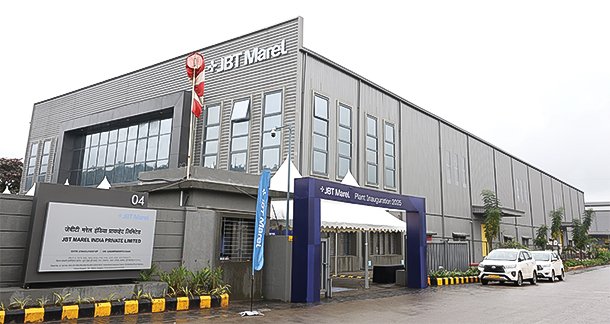
Our recently inaugurated GPC – Global Production Center at Pune plays a central role here—acting as an application, demo, and training center where we co-develop solutions with customers, test recipes, and fine-tune equipment for local poultry sizes, spice profiles, dairy, and plant-based products.
Local service and application experts are backed by global centers of excellence and shared digital tools, so customers get both world-class reliability and highly relevant, on-the-ground support.
Question– Looking at the next three to five years, what is the single biggest shift you expect in how food and beverage manufacturers will process and produce food , and what is JBT Marel doing now to make sure its customers are ready for it?
The biggest shift will be the move from fixed, labor‑dependent lines to flexible, software‑orchestrated, data‑driven factories.
Lines will adapt in real time to raw material variation, order mix, and labor availability—while meeting tighter sustainability and traceability demands.
JBT Marel is investing now in connected equipment, advanced analytics, and automation that can “self‑optimize” yield, energy, and quality across the line.
We’re also expanding regional capabilities—like GPC Pune and our Indian engineering and service teams—so customers in India, Sri Lanka, and Bangladesh can adopt these technologies at their own pace, with local support and application know‑how.